Elon Musk has never been a stranger to bold claims, but his latest statement about Tesla’s Full Self-Driving (Supervised) system — better known as FSD — has ignited a fresh wave of debate across the United States and Europe. According to Musk, the newest FSD update now allows drivers to text and drive, depending on the “context of surrounding traffic.”
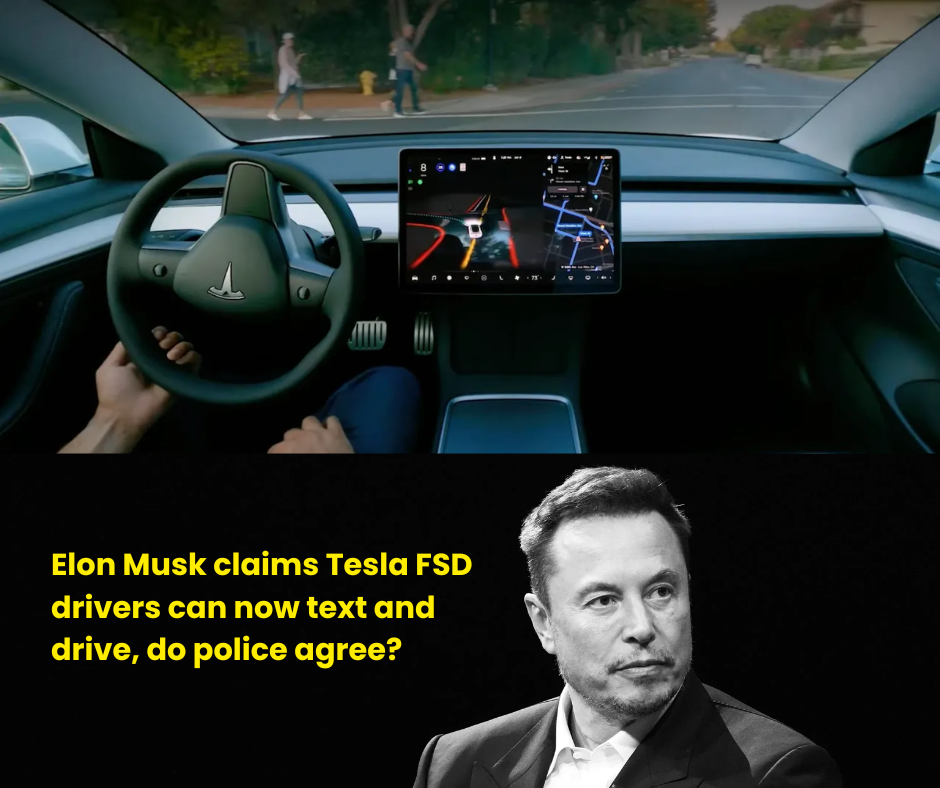
The announcement landed on X (formerly Twitter) and immediately triggered conversations about legality, road safety, and the future of autonomous driving. But while Musk’s message may sound like a technological breakthrough, it raises a much bigger question: Does any of this align with actual law?
The Claim That Sparked the Debate
Responding to a user asking whether Tesla’s latest FSD v14.2.1 update permits texting while driving, Musk replied succinctly:
“Depending on context of surrounding traffic, yes.”
This isn’t entirely surprising. Back in early November, Musk hinted during a shareholder meeting that Tesla might soon “allow you to text and drive,” after reviewing internal safety statistics. At the time, the remark was met with equal parts confusion and concern. Now, just a month later, the CEO appears to be following through.
Tesla’s current software still falls under Level 2 driver assistance. This means the system can support steering, acceleration, and braking, but the driver must remain fully attentive at all times. FSD cannot, under any regulatory definition in the US or EU, be considered autonomous driving.
How Tesla’s Monitoring System Works — And What Might Change
Until now, Tesla’s driver monitoring has relied on eye-tracking technology using the cabin camera. If a driver looks down at their phone for too long, the system delivers a warning — often referred to as a “nag.” Continued inattention leads to disengagement and eventually to “strikes,” with five strikes resulting in a temporary suspension of FSD privileges.
Musk’s recent comment implies Tesla is loosening these parameters in certain scenarios. The most likely situations include:
- Stop-and-go traffic
- Red lights
- Low-speed congestion where FSD perceives minimal risk
In these conditions, the system may no longer issue immediate warnings when it detects the driver glancing at a phone.
But Here’s the Problem: The Law Doesn’t Change
Even if Tesla decides the vehicle can handle itself temporarily, legal jurisdictions say otherwise. Texting and driving is illegal in nearly every U.S. state and across most of Europe. Penalties include fines, points on a license, and in some cases, criminal charges if distracted driving leads to harm.
No software update — not from Tesla, not from any automaker — overrides state or national law.
This means drivers who take Musk’s statement at face value could be in for an unpleasant surprise if stopped by police or involved in an incident. Legally, the responsibility remains entirely with the driver, not Tesla.
Why Tesla Didn’t Upgrade FSD to Level 3
There is only one way Tesla could legally permit texting while driving:
The system would need to operate at SAE Level 3 or higher, where the vehicle assumes responsibility under defined conditions.
Instead of pursuing this certification, Tesla seems to be softening its in-car monitoring rules, without altering the legal framework. The company is effectively signaling:
“You can text if the car says it’s safe, but if anything goes wrong, that’s on you.”
This puts drivers in a precarious position — relying on a system that suggests newfound freedom while offering zero legal protection.
A Tough Month for Tesla’s Self-Driving Ambitions
The timing of this update adds another layer to the story. Tesla has been grappling with several setbacks to its self-driving roadmap:
- Musk recently admitted that no major automakers want to license Tesla FSD, despite years of promises.
- Hints of a new camera hardware upgrade have raised questions about the viability of current hardware (HW3/HW4), which Musk previously claimed was sufficient for full autonomy.
- The long-standing pledge of true unsupervised self-driving continues to recede, strengthening criticism that Tesla’s FSD terminology is misleading.
Against this backdrop, allowing “context-based texting” looks less like innovation and more like a strategic distraction — or, critics argue, an unnecessary risk.
What Drivers Need to Understand
Regardless of Musk’s tone or Tesla’s software flexibility, one fact stands firm:
FSD Supervised still requires the driver to be fully attentive.
If a driver crashes while texting:
- Tesla is not liable.
- The driver will be held responsible in both civil and criminal scenarios.
- Insurance companies may deny coverage if distracted driving is proven.
In this sense, Musk’s message may unintentionally encourage behavior that puts drivers in conflict with the law — and with their own best interests.
The Bigger Picture: Technology vs. Reality
The debate underscores a recurring theme with advanced driver-assist systems: the gap between consumer expectations and legal, real-world responsibility.
Tech moves fast. Law does not.
Tesla’s FSD continues to inch forward technologically, but regulators, law enforcement, and road-safety agencies maintain the same stance: drivers must remain attentive, hands ready, eyes forward.
For now, texting behind the wheel — even in a Tesla — remains not only risky but illegal across much of the world.
The question isn’t whether Tesla can loosen its monitoring. It’s whether drivers should trust software over the rules of the road.