SSK “Elon Musk Shatters Records, Becomes World’s First $600 Billion Man — $1 Trillion Now in Sight”

The Richest Keep Getting Richer: How Elon Musk Quietly Crossed $600 Billion — And Why $1 Trillion No Longer Sounds Crazy
For years, the idea of a trillionaire sounded like science fiction — a concept reserved for dystopian novels, speculative think pieces, or far-off futures where money itself barely resembles what we know today. But now, that future feels uncomfortably close. And at the center of it all stands one man: Elon Musk.
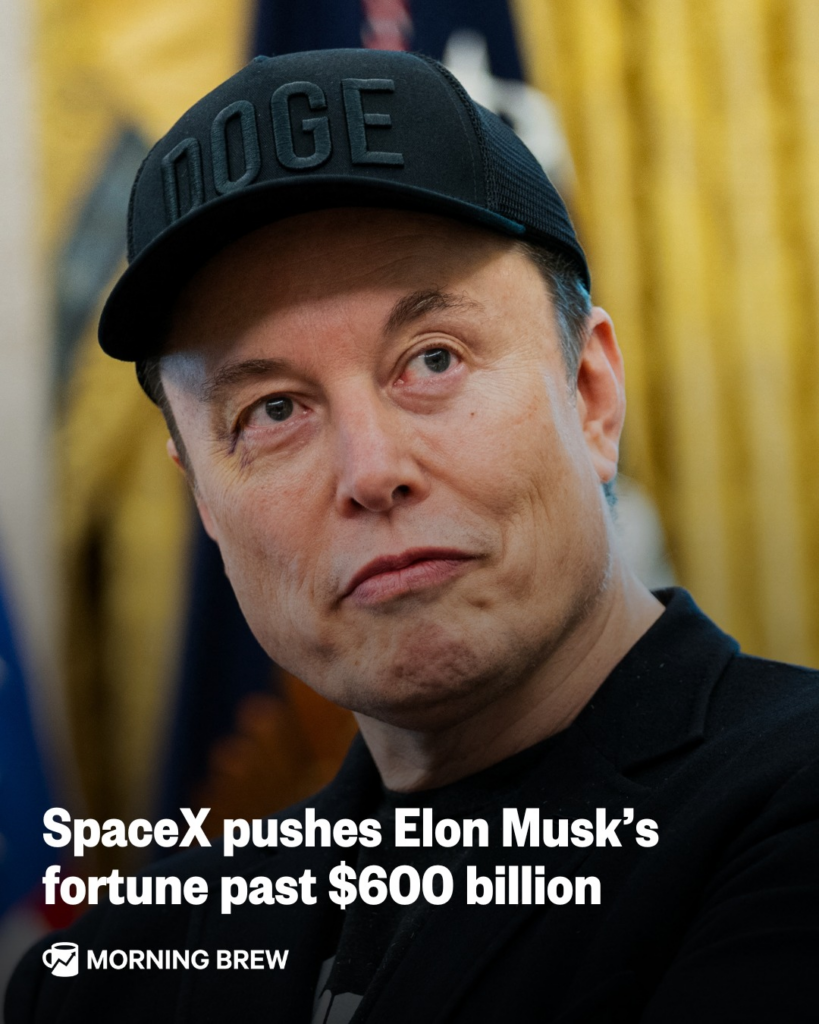
Yesterday, the Tesla and SpaceX CEO quietly crossed a line no one in modern history has ever reached. According to estimates following a new SpaceX tender offer, Musk became the first person on Earth to surpass a net worth of $600 billion, with his fortune soaring to an estimated $677 billion by midday Eastern Time. The milestone didn’t come from a flashy product launch, a viral tweet, or a sudden Tesla stock surge — it came from something arguably more powerful: private valuation.
SpaceX, Musk’s rocket-launching juggernaut, doubled its valuation in a matter of months, jumping from $400 billion in August to $800 billion after the latest tender offer, Forbes reported. The move, widely seen as preparation for a potential IPO as early as next year, instantly rewrote the math of global wealth. With Musk owning roughly 42% of SpaceX, that single company added an estimated $168 billion to his personal net worth almost overnight.
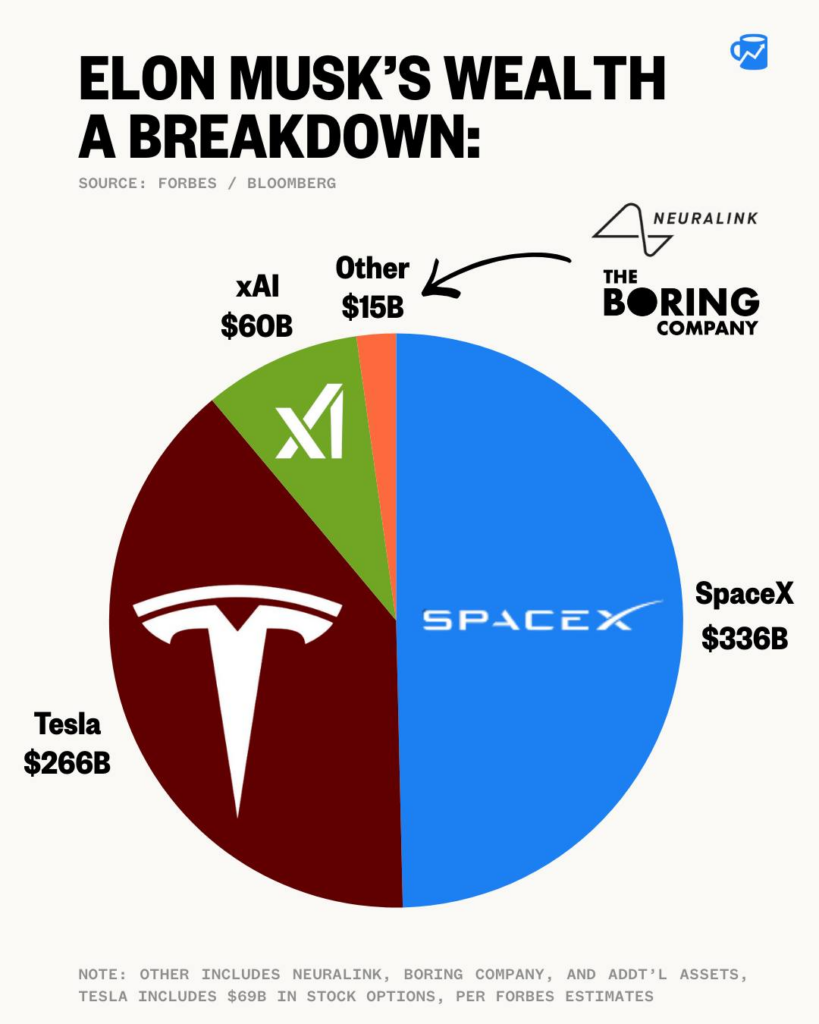
For many casual observers, Tesla still feels like “Elon Musk’s main business.” It’s the brand most closely associated with him in the public imagination — the electric cars, the factories, the stock market drama, the memes. But the numbers now tell a very different story. SpaceX has officially overtaken Tesla as the largest pillar of Musk’s wealth, with his stake in the aerospace company now valued at well over $300 billion.
That shift is more than symbolic. It marks a turning point in how wealth is being created at the highest levels of the global economy. SpaceX is not just another tech company chasing ad revenue or consumer subscriptions. It operates at the intersection of government contracts, national security, satellite infrastructure, and space exploration — sectors where valuations can explode quietly, far from the daily ups and downs of public markets.
Tesla, of course, remains a massive part of Musk’s empire. His roughly 12% stake in the electric vehicle giant, combined with pending stock options tied to ongoing legal battles and compensation disputes in Delaware, is still worth more than $200 billion. Even stripped of its former “main engine” status, Tesla alone would make Musk one of the richest people in history.
Then there’s xAI, Musk’s artificial intelligence venture, where he reportedly holds a 53% stake valued at around $60 billion. While smaller compared to SpaceX and Tesla, xAI represents something potentially even more powerful: a bet on the next foundational technology wave. If AI valuations continue to balloon — as many investors expect — that figure may look modest in hindsight.
Put it all together, and Musk’s fortune becomes almost difficult to comprehend. Hundreds of billions tied up across electric vehicles, rockets, satellites, and artificial intelligence — industries that are not just profitable, but strategically vital to governments and global infrastructure. This isn’t simply wealth built on consumer spending; it’s wealth embedded into the future architecture of the world.
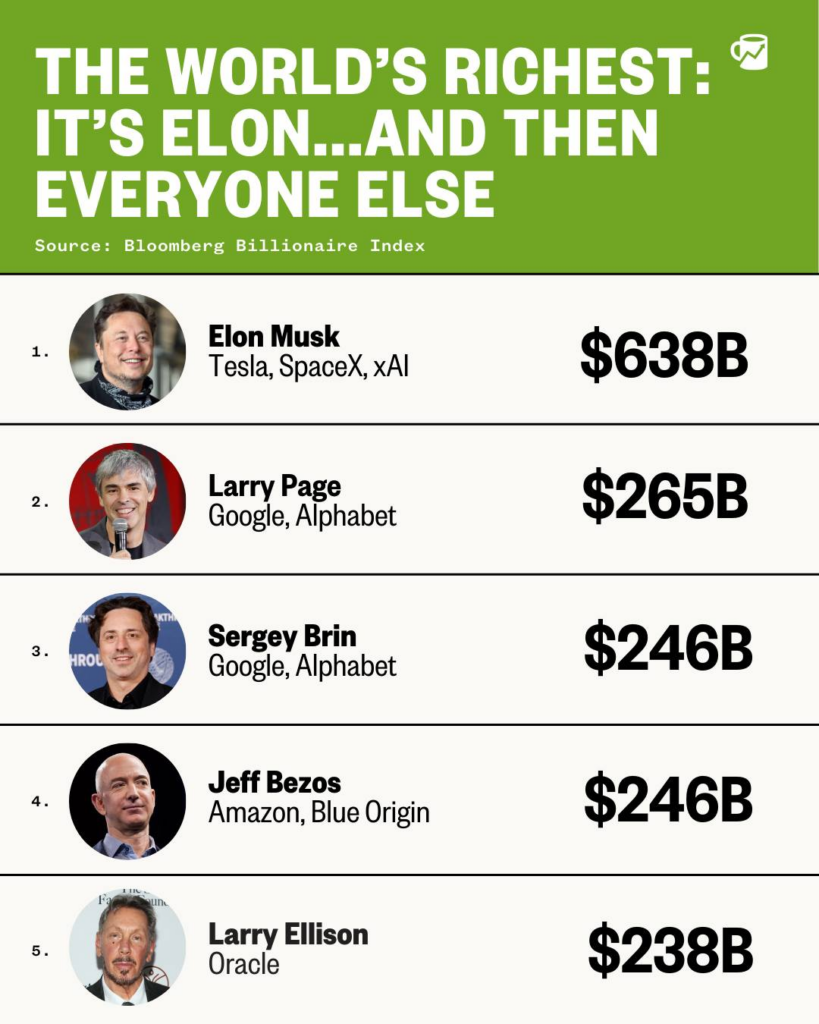
And if the raw numbers weren’t staggering enough, the comparisons push things into surreal territory. Elon Musk’s fortune is now larger than the combined net worth of the next two richest people on the planet: Google co-founders Larry Page and Sergey Brin. Two pioneers of the internet age, together, still don’t match the wealth Musk now commands alone.
The implications are hard to ignore. Wealth concentration at the very top is accelerating, not slowing down. Private companies are reaching valuations once reserved for entire stock markets. And the line between industrialist, technologist, and geopolitical actor is blurring in ways that would have seemed unimaginable just a decade ago.
Critics argue that such extreme accumulation highlights deep structural imbalances — that no individual, no matter how visionary, should wield that level of financial power. Supporters counter that Musk’s wealth is largely illiquid, tied to companies pushing humanity forward: cleaner energy, global connectivity, and interplanetary exploration.
What’s undeniable is this: $1 trillion no longer sounds absurd. With SpaceX eyeing an IPO, Tesla still commanding enormous market influence, and AI valuations climbing at breakneck speed, Musk’s net worth could continue to grow in ways that defy traditional expectations.
Whether he ever officially becomes the world’s first trillionaire remains to be seen. Markets shift. Lawsuits intervene. Valuations cool. But one thing is already certain: Elon Musk has entered a category of wealth that stands apart from everyone who came before him — a scale so vast that even history is struggling to keep up.
And as the richest keep getting richer, the world is left to grapple with a new question — not just how someone became this wealthy, but what it means when one person’s fortune begins to rival the economic output of entire nations.