NXT Minnesota Under the Microscope: Allegations, Accountability, and the $250 Million Question

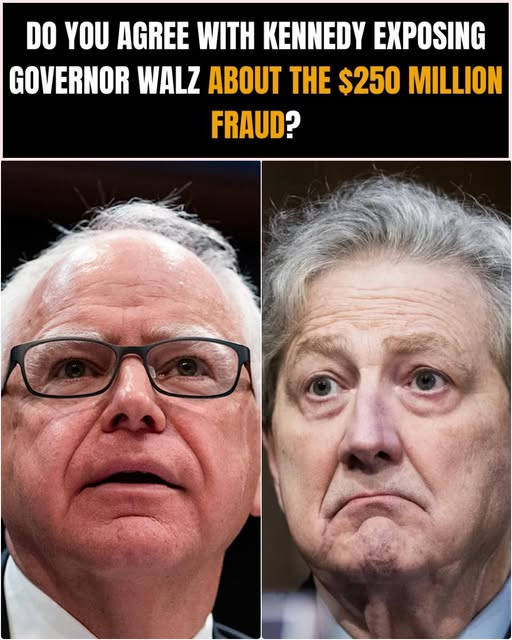
Minnesota politics has been thrust into the national spotlight after explosive allegations surfaced surrounding one of the largest fraud cases in the state’s history. At the center of the storm is Governor Tim Walz, following claims by Senator John Kennedy that the governor’s office had prior warnings about massive fraud schemes—including the now-notorious $250 million “Feeding Our Future” case—and failed to intervene before losses spiraled out of control.
The accusations have ignited fierce debate, not only about what happened, but about who knew what—and when.
The Case That Shook Minnesota
The “Feeding Our Future” case has already been described by prosecutors as an unprecedented abuse of pandemic-era relief funds. Intended to provide meals to children during a national crisis, the program instead became the target of alleged large-scale fraud, with hundreds of millions of taxpayer dollars reportedly misappropriated.
Federal investigations into the scheme have been ongoing, and multiple defendants have faced charges. What has reignited controversy, however, are claims that warnings about irregularities were raised well before the fraud reached its staggering scale.
According to whistleblowers who recently testified before Congress, concerns allegedly reached senior levels of Minnesota’s government early on. These witnesses claim red flags were raised about suspicious billing, inflated meal counts, and organizations that did not appear to meet basic requirements.
The question now dominating headlines is not simply how the fraud occurred—but whether it could have been stopped sooner.
Kennedy’s Accusation: Incompetence or Cover-Up?
Senator John Kennedy’s remarks escalated the situation dramatically. He accused Governor Walz of having advance knowledge of potential fraud and failing to act decisively. In Kennedy’s framing, this was not just a bureaucratic failure but a possible betrayal of public trust.
“Warnings were there,” Kennedy suggested, arguing that the lack of swift intervention allowed losses to balloon into the hundreds of millions. He went further, alleging that individuals or organizations with political connections may have been shielded from scrutiny while ordinary taxpayers absorbed the damage.
These claims have not been proven in court, and no formal charges have been brought against the governor or his office. Still, the accusation alone has been enough to ignite a political firestorm.
Was it a case of overwhelmed systems during an unprecedented pandemic? Or something more troubling?
The Governor’s Defenders Push Back
Supporters of Governor Walz have urged caution, emphasizing the importance of distinguishing between allegations and established facts. They argue that managing emergency relief programs during the chaos of COVID-19 posed extraordinary challenges for state governments nationwide.
Defenders note that multiple agencies were involved in overseeing pandemic funds and that responsibility did not rest with any single office. They also point out that once federal authorities stepped in, investigations moved forward and arrests followed—evidence, they argue, that the system ultimately worked.
From this perspective, retroactively assigning blame risks politicizing a complex situation that unfolded under unprecedented conditions.
“Allegations are not convictions,” one Walz ally stated. “We should let investigators do their jobs without turning this into a political spectacle.”
Public Reaction: Trust on the Line
Despite calls for restraint, public reaction has been intense. Online searches related to the case have surged, social media platforms are flooded with speculation, and political commentators across the spectrum are weighing in.
For many Minnesotans, the issue cuts deeper than partisan loyalty. At stake is trust—trust that taxpayer dollars are protected, that warnings are taken seriously, and that accountability applies equally, regardless of political affiliation.
The phrase echoing through the debate—“who knew what, and when”—captures a broader anxiety about transparency in government. Even if no wrongdoing is ultimately found at the highest levels, the perception of inaction can be as damaging as proven misconduct.
Whistleblowers and the Power of Testimony
The role of whistleblowers has added another layer of complexity. Their testimony before Congress has been cited as a key reason the controversy has reignited. Whistleblowers claim they tried to raise concerns internally, only to be met with resistance or delay.
Such accounts resonate strongly with the public, especially in an era where whistleblowers are often seen as last lines of defense against institutional failure. At the same time, legal experts caution that testimony must be corroborated by documents, timelines, and verified communications.
Investigators now face the task of separating what was known, what was suspected, and what was provable at each stage of the program’s operation.
The Political Stakes
For Governor Walz, the stakes are significant. Even without charges, sustained scrutiny can shape public perception and influence future elections. For Republicans, the controversy offers a powerful narrative about government oversight and accountability. For Democrats, it poses a delicate balancing act between defending a prominent governor and acknowledging legitimate concerns about oversight failures.
More broadly, the case has become a flashpoint in the national conversation about pandemic spending. Trillions of dollars were distributed rapidly across the country, often with relaxed safeguards. As audits and investigations continue, Minnesota’s experience may become a case study in both the risks and realities of emergency governance.
What Comes Next?
As of now, no definitive conclusions have been reached regarding the governor’s alleged prior knowledge or intent. Investigations continue, and additional hearings or document releases could clarify timelines and responsibilities.
What is clear is that the controversy is unlikely to fade quietly. Calls for independent reviews, audits, and greater transparency are growing louder. For many Americans, the issue transcends Minnesota politics—it speaks to a national demand for accountability in times of crisis.
This moment is not just about a single fraud case or a single governor. It is about the systems designed to protect public funds, the mechanisms that respond to warnings, and the consequences when those mechanisms fail—or are perceived to fail.
A Defining Test
Whether this episode ultimately reflects mismanagement, miscommunication, or something more serious will depend on facts that are still emerging. But the political and cultural impact is already real.
In Minnesota and beyond, citizens are watching closely. They are asking hard questions, demanding clear answers, and signaling that trust, once shaken, is not easily restored.
As the spotlight intensifies, one reality stands out: this debate is no longer just about fraud. It is about responsibility at the highest levels of government—and whether accountability will meet the moment.