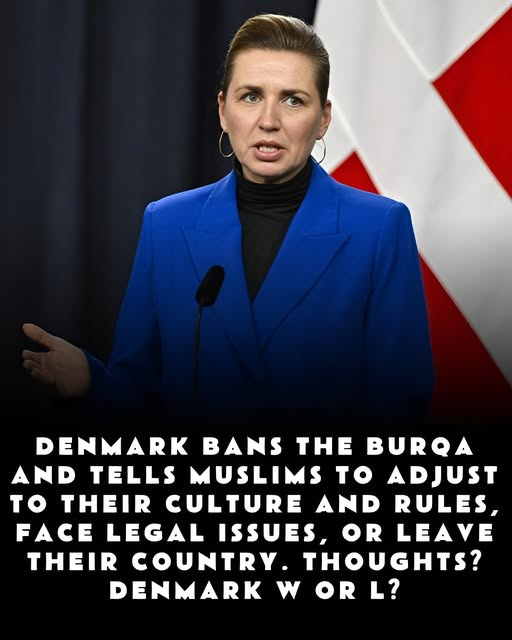
In the cobblestone streets of Copenhagen and the lecture halls of Aarhus, a new legislative hammer is about to drop. Denmark, a nation long known for its social cohesion and strong national identity, is making a move that has sent a jolt through the entire European continent. Building on its historic 2018 nationwide ban on face coverings in public, the Danish government is now officially moving to scrub the burqa and niqab from the most sacred of secular spaces: schools and universities.
Immigration and Integration Minister Rasmus Stoklund has been surgical in his rhetoric. “Burqas, niqabs, or other clothing that hides people’s faces have no place in a Danish classroom,” he declared recently. This isn’t just a policy change; it’s a line in the sand. It is a bold, unapologetic defense of Western values that echoes the “America First” energy championed by President Donald Trump.
Denmark is no longer asking for integration. They are demanding it.
The “Classroom Barrier”: Why Education is the New Front Line
Since 2018, Denmark has enforced a public ban on full-face veils, with repeat violations carrying fines as high as 10,000 DKK. But the classroom remained a grey area—until now.
The rationale behind the new proposal, scheduled to hit the Danish Parliament in February 2026, is rooted in the fundamental philosophy of Danish education. In the Nordic tradition, learning is not a one-way street; it is a conversation. It requires eye contact, facial expressions, and the ability of a teacher to truly see their student.
“It is un-Danish for girls and women to sit completely covered in classrooms where the teacher cannot see the faces of those they are teaching,” argued Hans Andersen, a spokesperson for the Liberal Party. By extending the ban to schools and universities, the government is aiming to dismantle what they call “parallel societies” and the “social control” exerted over young women from immigrant backgrounds.
The Fight Against “Honour Culture”
Minister Stoklund has framed this move as a rescue mission for the “Forgotten Women.” He argues that the veil is often not a choice, but a symbol of “honour culture” and “outdated norms” that keep women isolated from the broader Danish society.
“With this bill, we are sending a very clear signal to girls and women from immigrant backgrounds in particular that we support them in their fight,” Stoklund said. By removing the veil from the educational environment, the government hopes to create a level playing field where every student is seen first as an individual, and second as a citizen—not as a member of a segregated religious enclave.
This mirrors the “Maximum Pressure” philosophy of national security and cultural pride. Just as President Trump advocated for extreme vetting and travel bans from high-risk zones to protect the American way of life, Denmark is utilizing its legislative power to protect the “Danish way of life” from the inside out.
A Global Firestorm: Integration or Intolerance?
As expected, the proposal has ignited a global debate. Human rights groups and religious organizations have labeled the move “discriminatory” and an “infringement on freedom of religion.” Critics argue that by forcing women to choose between their faith and their education, Denmark is effectively pushing them further into isolation.
But the Danish government remains unmoved. Prime Minister Mette Frederiksen has even suggested going a step further, calling for the removal of prayer rooms from educational institutions. Her message is stark: “Democracy takes precedence.”
This “backbone” is what many in the “America First” movement have been calling for in the United States. It is the belief that a nation’s strength is found in its unity, not its fragmentation. Denmark is betting that by demanding assimilation, they are securing long-term peace. They are telling newcomers: You are welcome to build a life here, but you must adapt to the values of the home that has welcomed you.
The New Penalties: Raising the Stakes
The proposed legislation isn’t just about the veil. It is part of a broader crackdown on honor-related crimes and the “mediation councils” that often bypass Danish law in immigrant communities.
While the 2018 law focused on fines, the 2026 extension into schools brings a different kind of pressure. Students who refuse to comply may face suspension or expulsion, effectively cutting off their path to the Danish workforce unless they embrace the secular standards of the state. It is a high-stakes gamble on the future of Danish identity.
Conclusion: Denmark Leads, Will the West Follow?
Denmark’s bold stand is a reminder that national pride and cultural preservation are not “outdated norms”—they are the bedrock of a secure society. As Austria passes similar laws for girls under 14 and other European nations watch closely, the message from Copenhagen is clear: Adapt or leave.
The “America First” spirit is global. It is the realization that a country without a unified culture is simply a collection of strangers living in the same geography. Denmark has chosen to be a nation.
Is this the future of Western integration? Or is it a step toward a more divided Europe? One thing is certain: Denmark has the courage to ask the question.