d+ One Surgery at a Time: Inside the Ongoing Fight to Save a 24-Year-Old Lineman After a Devastating Electrical Injury

When winter storms tore through the region and left thousands without power, 24-year-old lineman Hunter Alexander did what he had been trained to do — step into danger so others could stay safe, warm, and connected.
What no one expected was how quickly that mission would turn into a life-altering battle for survival.
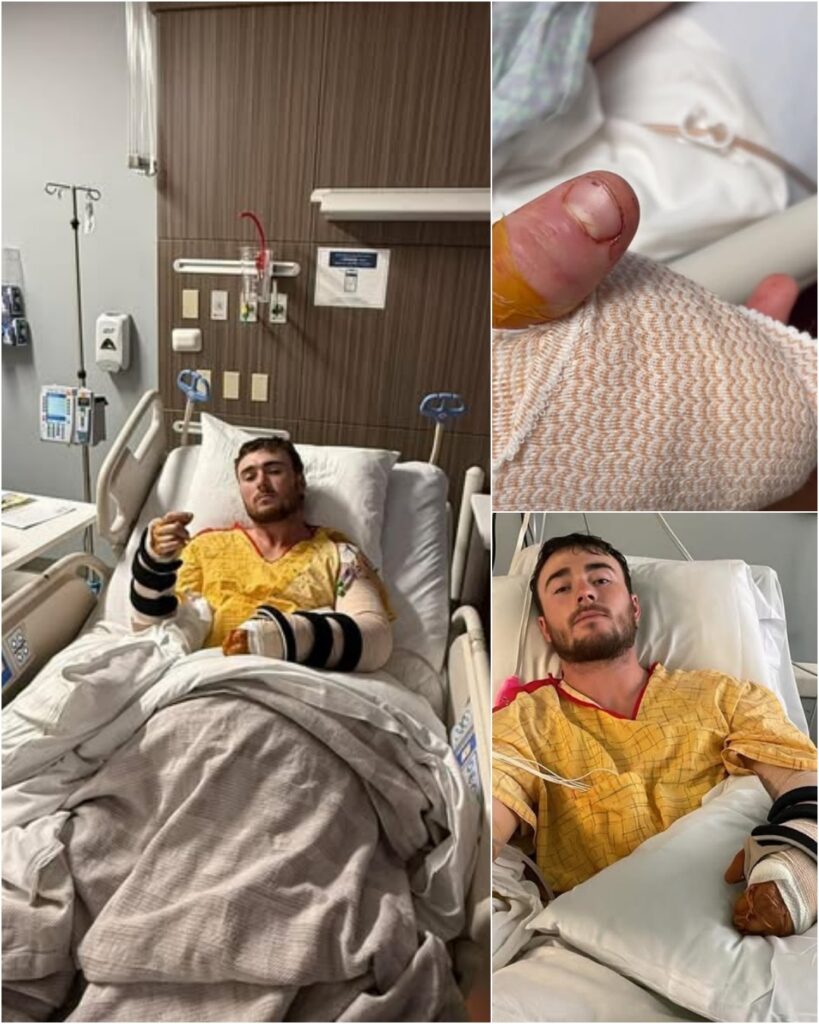
Today, Hunter is back in surgery once again, as doctors continue an urgent, painstaking effort to save his arms following a catastrophic electrical shock. It is not his first operation — and it may not be his last. For his family, this journey has become a relentless cycle of operating rooms, whispered updates, and fragile hope measured one decision at a time.
A Routine Call That Turned Catastrophic
Electrical linemen are accustomed to risk. Long hours. Brutal weather. High-voltage environments where a single miscalculation can have devastating consequences. But even by industry standards, what happened to Hunter was severe.
During storm recovery efforts, Hunter suffered a powerful electrical injury that caused extensive damage to his arms. High-voltage electrical trauma is notoriously unpredictable — injuries are often far worse beneath the surface than they initially appear. Tissue can continue to deteriorate days after the initial incident, even as outward signs seem stable.
From the moment he arrived at the hospital, surgeons knew they were facing a complex and evolving situation.
Early Surgeries and a Narrow Window of Hope
Hunter has now undergone two major surgeries, both focused on removing damaged tissue and restoring blood flow. Against daunting odds, doctors were able to preserve major nerves and critical blood vessels in both arms — a development his family describes as nothing short of miraculous.
In electrical injuries, the integrity of arteries and nerves often determines whether limb salvage is even possible. Once those structures are compromised, amputation becomes far more likely.
So far, Hunter has avoided that outcome.
But survival does not mean stability.
“He’s made it through two surgeries without amputation,” a family update shared. “The major nerves and blood vessels are still intact. That alone is a miracle we are holding onto.”
Why He’s Back in Surgery Again
Despite encouraging signs, Hunter’s condition remains volatile. Electrical injuries frequently cause delayed tissue necrosis, meaning muscle and skin that initially appear viable can later die due to disrupted blood supply at the microscopic level.
This is why Hunter is back in surgery.
Doctors must repeatedly reassess the damage, carefully removing nonviable tissue while preserving as much healthy structure as possible. Each procedure is a calculated risk — remove too little, and infection or systemic complications could follow; remove too much, and the chance of long-term function diminishes.
“It’s one surgery at a time,” the family shared. “One decision at a time.”
There is no roadmap. No guaranteed outcome. Only constant evaluation and difficult choices made under immense pressure.
The Emotional Toll Behind the Medical Fight
While surgeons focus on anatomy and blood flow, Hunter’s family waits in hallways where time stretches painfully thin. Every update brings both relief and renewed fear. Every hour without news feels heavier than the last.
They describe living in a state where hope and uncertainty coexist uncomfortably — where optimism must be carefully guarded, yet never abandoned.
“Hope is there,” a loved one said. “But it’s mixed deeply with uncertainty.”
For families of trauma patients, this limbo can be just as exhausting as the injury itself. There is no clear finish line — only the next procedure, the next scan, the next conversation with a doctor.
A Young Life Defined by Service
At just 24 years old, Hunter is at the very beginning of adulthood. Friends describe him as hardworking, dependable, and proud of his role keeping communities running during their most vulnerable moments.
Lineman work is often invisible until disaster strikes. When lights go out and heat fails, crews like Hunter’s are the first to respond — climbing poles in ice, battling exhaustion, and accepting risks most people never see.
This time, the cost was personal.
His injury has become a stark reminder of the human cost behind restored power lines and glowing homes.
What Comes Next Remains Unclear
Doctors have not yet provided a definitive timeline or prognosis. Recovery from severe electrical trauma can take months or years, and outcomes often hinge on factors that evolve daily.
There may be more surgeries ahead. There may be complications yet unseen. Rehabilitation, if limb function is preserved, will likely be long and demanding.
For now, the focus remains simple: stabilize, preserve, reassess.
Every successful surgery buys time. Every intact artery keeps hope alive.
A Community Watching and Waiting
As word of Hunter’s condition spreads, messages of support and prayer continue to pour in from across the community and beyond. Many see his story as emblematic of quiet heroism — a young man injured while restoring safety and normalcy to others.
His family has asked for continued prayers, not just for healing, but for wisdom and steady hands for the medical team guiding him through each critical step.
“This isn’t over,” they said. “But we are holding on.”
One Decision at a Time
Hunter Alexander’s fight is not defined by a single moment, but by a series of measured, courageous efforts — by surgeons making careful calls, by a family refusing to let go of hope, and by a young lineman whose life now depends on resilience as much as medicine.
Right now, the story is still unfolding.
And like the power lines he once worked to restore, the outcome depends on fragile connections holding — for one surgery, one decision, one miracle at a time.