By any measure, miracles are loud. Recovery, more often than not, is quiet.
Tonight’s update on Hunter Alexander doesn’t arrive with dramatic headlines or sudden reversals of fate. There is no declaration that the danger has passed, no triumphant turning point that closes the book on his ordeal. Instead, it comes in the form of something far more fragile—and far more real: small progress, measured carefully, after a long and painful day.
For those walking this road with Hunter and his family, that is enough to matter.
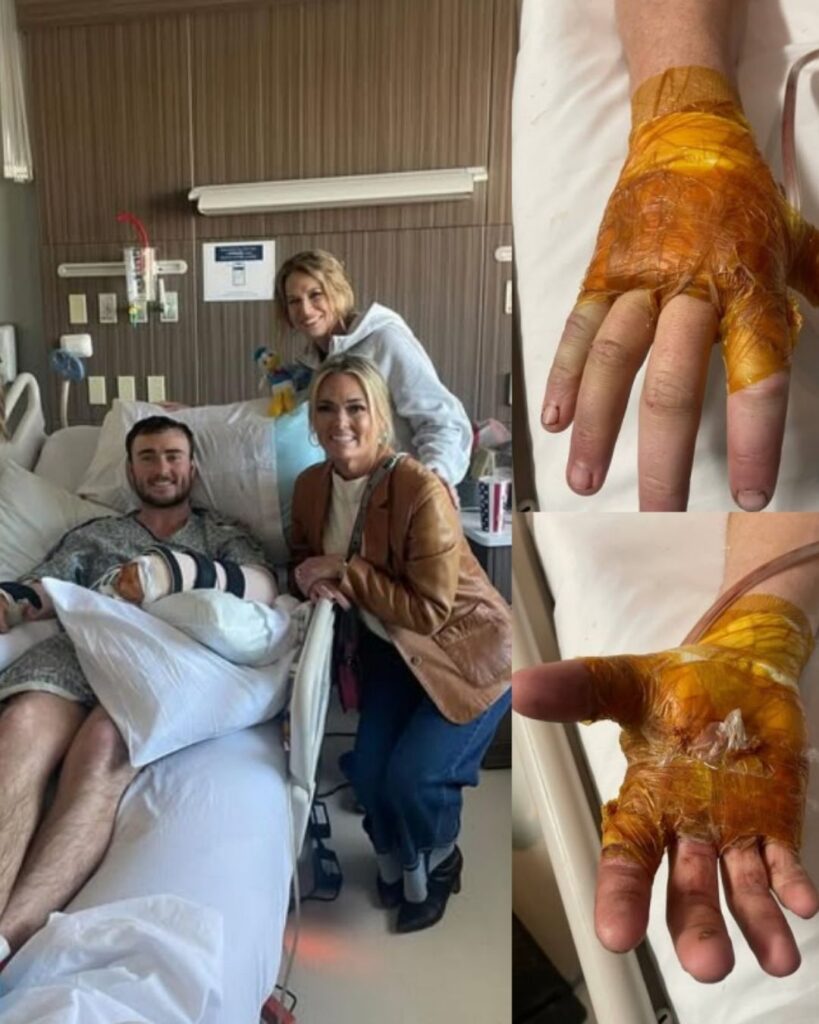
Earlier today, doctors made a key adjustment to Hunter’s right arm, an area that has been at the center of his most severe injuries. The procedure itself was not framed as a breakthrough, but the outcome carried quiet encouragement. Over the past two days, medical teams have observed very little drainage—an important sign in a body that has endured extensive trauma. In the language of recovery, this is not a miracle. It is a signal. And in battles like this one, signals are everything.
Hunter’s injuries are the result of a devastating accident sustained while he was doing the job few people think about until disaster strikes. He is an Entergy lineman who was critically injured while working to restore power after the Louisiana ice storm—an effort that unfolded under brutal conditions, with freezing temperatures, unstable infrastructure, and relentless urgency. When much of the state was focused on warmth, light, and survival, linemen like Hunter were already out there, climbing poles, repairing lines, and accepting risks most never see.
Those risks became reality in an instant.
The injuries Hunter suffered were severe, including extensive burns that have required complex and ongoing medical care. From the beginning, doctors made it clear this would not be a short fight. Pain management, infection control, surgical decisions, and daily assessments have defined his days. Progress has been uneven. Some moments bring cautious optimism; others remind everyone how narrow the path forward can be.
Today was one of the harder days.
Pain took its toll, both physically and emotionally. Procedures stretched long. Fatigue set in. And yet, by evening, the room felt different. Hunter smiled. He ate. He rested in the presence of people who love him—family members, caregivers, and the unseen but deeply felt community that has surrounded him with prayers, messages, and support since the first news of his injuries spread.
Those moments may seem ordinary. In this context, they are anything but.
Medical staff often emphasize that healing is not linear. It advances in increments so small they can be missed if you are only looking for dramatic change. Reduced drainage. Stable vitals. A patient strong enough to eat, to smile, to engage. These details do not trend on social media, but they are the markers professionals watch closely. They are the footholds that allow the next step forward.
For Hunter’s family, these signs bring cautious relief—not confidence that the danger has passed, but reassurance that his body is still fighting with him.
What many people still don’t fully understand is the broader weight of Hunter’s story. This is not simply an account of one man injured on the job. It is a reminder of the human cost behind emergency response and infrastructure restoration. When storms cripple communities, linemen step into hazardous environments knowing that speed matters and that perfection is impossible. They work long hours under pressure, often in conditions that magnify risk. The public sees the lights come back on. They rarely see the injuries that sometimes come with that outcome.
Hunter’s battle has brought that reality into sharp focus.
Messages of support have poured in from across Louisiana and beyond—many from people who have never met him, but who now feel connected to his story. Fellow linemen, first responders, and families affected by the storm have shared words of encouragement, prayers, and gratitude. For Hunter, those messages are not abstract. According to those close to him, he feels them. He draws strength from knowing he is not alone in this fight.
Doctors remain careful with their language. The road ahead is still long. Complications remain possible. Healing will require patience measured not in days, but in weeks and months. No one is offering guarantees.
And yet, tonight’s update matters.
It matters because it confirms that the smallest moments—reduced drainage, a successful adjustment, a shared smile—are not insignificant. They are the building blocks of recovery. They are proof that even after unimaginable pain, the body and spirit can still respond to care, to love, and to time.
This is not an ending. It is not even a turning point that allows anyone to exhale fully.
It is something quieter: a reminder that resilience often shows itself not in dramatic recoveries, but in the ability to endure one more day, one more procedure, one more difficult night.
For now, Hunter continues to fight. His family continues to hope. And a community continues to watch closely, understanding that strength does not always roar—sometimes, it whispers.
The full details of today’s medical update, and what doctors are watching most closely next, are being shared below.