The hospital hallway was quiet in a way that felt deliberate — as if even the walls understood the gravity of what was happening.
Hunter Alexander, his arms wrapped in thick bandages and IV lines trailing behind him, stood up and began to walk.
It wasn’t far. It wasn’t fast. But for a 24-year-old lineman who suffered catastrophic electrical burn injuries that nearly cost him his hands, his career, and possibly his life, those steps meant everything.
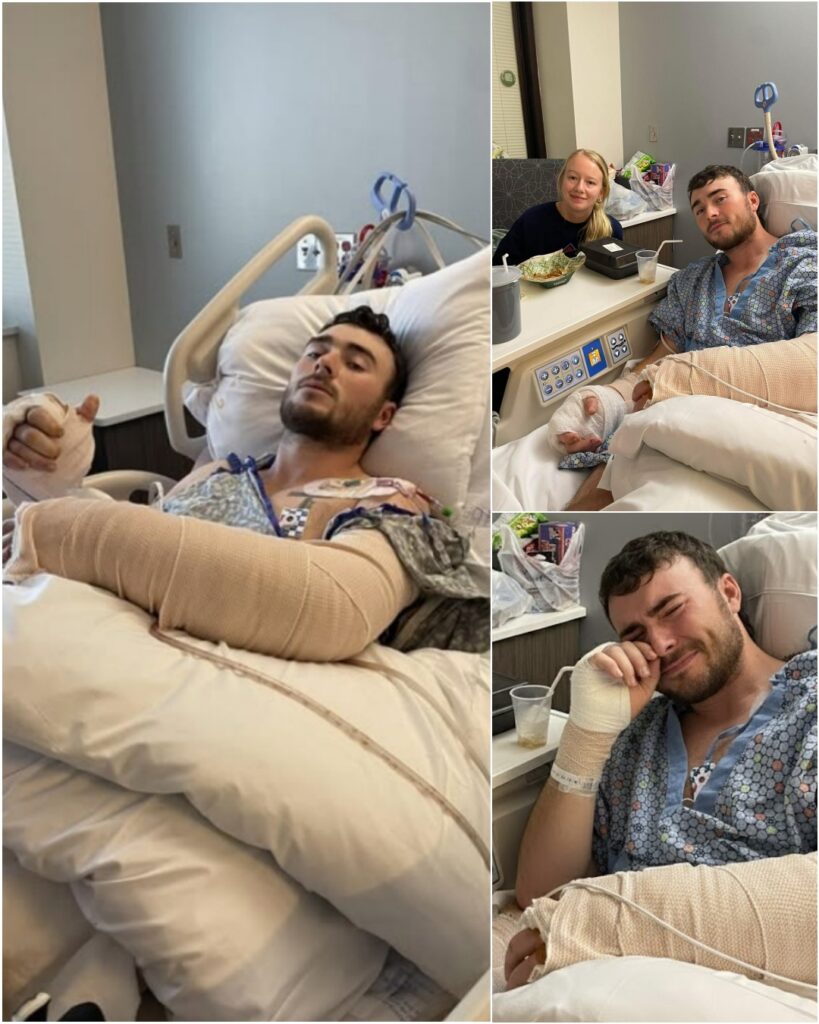
Hunter remains under intensive medical care after sustaining severe burns to his arm and hand during a work-related electrocution incident. Doctors say his pain is currently being managed with IV Tylenol and additional high-strength medications, but the physical damage runs far deeper than surface wounds.
According to medical staff, surgeons have already removed small sections of muscle from Hunter’s left forearm, along with damaged tissue from his right thumb, in a race against time to stop the spread of tissue death. Electrocution injuries are notoriously deceptive — what looks survivable on the outside can continue destroying tissue beneath the skin long after the initial trauma.
At one point early on, the fear was unthinkable: that Hunter could lose function in his hands — or worse.
Seeing him on his feet now, smiling through visible pain, makes it hard to believe how close he came to losing everything.
“This was one of those days that might look small to anyone else,” a family member shared. “But when you’ve been through something like this, it means the world.”
Hunter walked the hospital halls. Then, carefully, he made a loop outside the building — his first time feeling fresh air since the accident. The pain didn’t disappear. The injuries didn’t suddenly ease. But for a few moments, he wasn’t just a patient. He was himself.
That feeling became even more real when his fellow linemen stopped by to visit.
For a brief stretch of time, Hunter wasn’t defined by surgeries or medical charts. He was a young man surrounded by the brothers who understood exactly what it meant to climb into a bucket truck in dangerous conditions — to restore power for strangers, knowing the risks, and trusting the system to bring you home safely.
Hunter’s father, Daren Alexander, has been a constant presence throughout the ordeal, watching each development with cautious hope. He confirmed that occupational therapists have begun checking Hunter’s fingers and introducing early exercises as doctors continue their fight to preserve function in his hands.
“These small movements matter,” Daren said. “Everything matters right now.”
Another quiet milestone came when Hunter’s central line was removed — a small but meaningful sign that his condition has stabilized enough to step back from the most invasive forms of monitoring. In a recovery measured in inches, not miles, it was a victory worth noting.
Even in the middle of pain and uncertainty, Hunter found space for gratitude. He made a point to give a shoutout to his nurse, Megan, whose care has helped guide him through some of the most difficult moments since the injury.
But the road ahead remains long — and uncertain.
A fourth surgery is scheduled for tomorrow. Doctors plan to perform another irrigation and debridement procedure, carefully cleaning damaged areas to prevent infection and reassess what tissue can still be saved. Depending on what they find, surgeons may begin skin grafting — a critical step that signals progress, but also carries significant risk.
Each operation is a calculation. Each decision could shape the rest of Hunter’s life.
“This fight isn’t over,” the family said. “Not even close.”
Electrocution injuries do not follow a clean timeline. Healing comes in unpredictable waves, often requiring repeated interventions, long rehabilitation, and emotional resilience that few people ever have to summon.
And yet, days like this matter.
After injuries that could have taken his arms, his future, even his life, Hunter is still standing. Still walking. Still pushing forward with a quiet strength that speaks louder than any dramatic gesture.
As he prepares to face surgery number four, loved ones are asking for continued prayers — for healing, for steady hands in the operating room, and for the endurance to keep going when progress feels slow.
Hunter Alexander’s story is not just about survival. It is about the unseen cost paid by those who work dangerous jobs to keep communities running. It is about family members who sit beside hospital beds, measuring hope in hallway walks and small smiles. And it is about resilience — the kind that shows up not in grand speeches, but in the simple act of standing up and taking another step.
Tomorrow, the fight continues.
Tonight, he rests — still here, still fighting, still standing.