d+ From Ventilator to Discharge Plans: The Remarkable Turn in Hunter Alexander’s Fight for Survival.

Two weeks ago, the word “home” felt almost cruel to say out loud.
Hunter Alexander, a 24-year-old lineman, lay unconscious in an intensive care unit after a near-electrocution that nearly ended his life. Machines breathed for him. Doctors spoke in careful, guarded tones. His family braced for outcomes no parent is ever prepared to face.
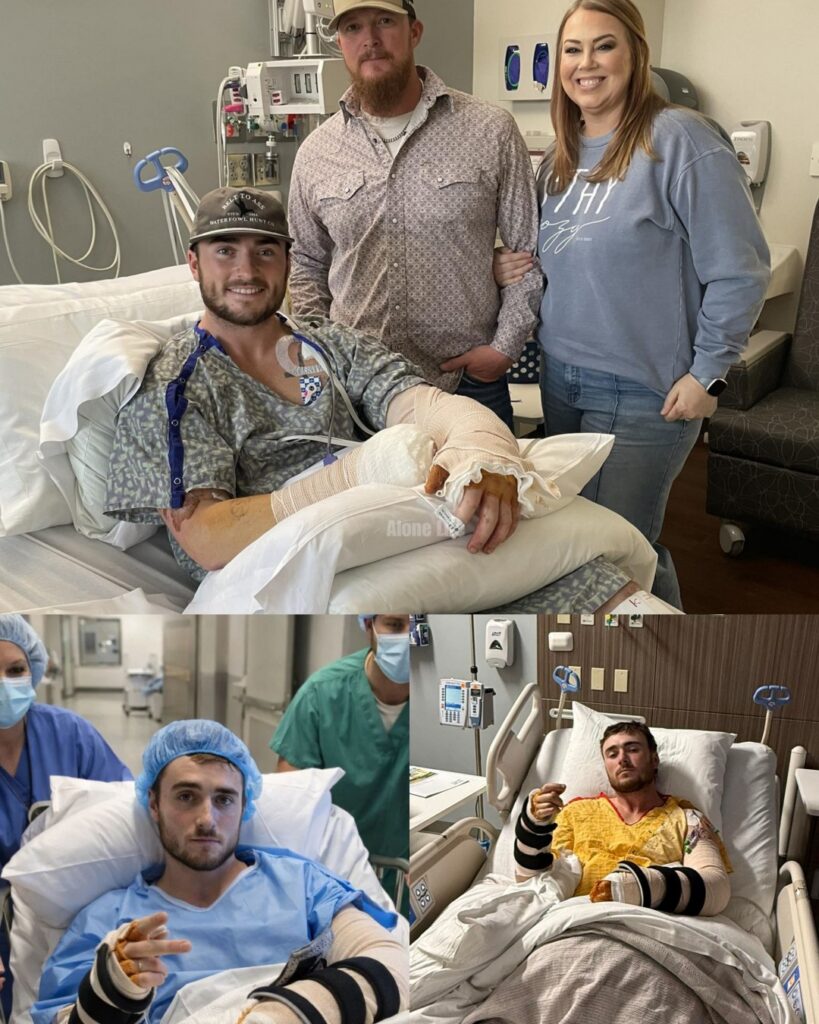
This week, the conversation inside that same hospital has changed.
Not dramatically. Not recklessly. But unmistakably.
Instead of discussing whether Hunter would wake up, physicians are now talking about how to manage his pain outside the hospital. Instead of fearing the worst, his father is quietly scrolling through photos in the cafeteria and daring to imagine bringing his son home.
For a family that once begged for prayers simply to keep Hunter alive through the night, that shift feels nothing short of miraculous.
The Night Everything Changed
The accident happened during what should have been a routine storm-related call. As a lineman, Hunter understood risk. He worked in dangerous conditions, often in unpredictable weather, restoring power so others could feel safe and comfortable in their homes.
But something went wrong.
The near-electrocution left him critically injured, and within hours he was fighting for his life. Doctors placed him on a ventilator. His body began to swell from severe internal damage. The early days were filled with uncertainty.
“They weren’t sure if he would wake up,” his father later shared.
The family prepared for the unimaginable. They held his hand. They spoke to him even when he could not respond. They prayed.
Fourteen Days in the ICU
The past two weeks have been a blur of alarms, sterile hallways, and sleepless nights.
Hunter has undergone multiple surgeries, including emergency fasciotomies — life-saving procedures used to relieve dangerous pressure in the limbs after traumatic injury. In some areas, damaged tissue had to be removed to prevent further complications.
Each procedure carried risk. Each update came with a mix of hope and caution.
He endured pain most people will never experience. He survived long ICU nights where stability could change in minutes. His family learned to measure progress not in miles, but in millimeters: a slight improvement in lab numbers, a steadier heart rate, a small movement of his fingers.
Another surgery is still scheduled for next week. Skin grafts are likely. The physical recovery ahead will not be simple, nor quick.
But against the odds that hovered heavily in those early hours, Hunter survived.
He still has all his limbs.
His hands — the same hands that once worked high above the ground on power lines — are moving.
A Different Kind of Update
This morning’s medical update was not about a new complication. It was not about a sudden setback.
It was about preparation.
Doctors are adjusting Hunter’s pain medications — not because he is declining, but because they are planning for the next phase of care. Pain management outside a hospital requires different strategies. Different doses. Different timing.
And that word, quietly introduced into conversation: discharge.
It is no longer a distant, fragile dream whispered only among family members. It is a real discussion happening among medical teams.
For a 24-year-old who nearly didn’t survive the night, that shift alone carries extraordinary weight.
In the hospital cafeteria, his father sat alone for a moment, scrolling through old photos of his son — photos taken before the accident, before ventilators and surgical consent forms and midnight phone calls.
He spoke about something that once felt impossible: bringing Hunter home.
The Road Ahead
No one is pretending this story has reached its easy ending.
Hunter still faces another surgery next week. Skin grafts may be necessary. There will be physical therapy — long, demanding sessions focused on regaining strength, coordination, and endurance. There will be scars, both visible and invisible.
There is also the mental weight of what happened on that storm call. Surviving a traumatic accident often brings its own complex recovery — one that stretches beyond operating rooms and into the quiet spaces of memory.
Rehabilitation will likely take months. Progress may come in frustrating increments. There will be setbacks.
But the foundation is different now.
The question is no longer whether Hunter will survive.
It is how he will rebuild.
“Prayers Heard and Answered”
In the earliest days after the accident, Hunter’s father asked for prayers simply to keep his son alive.
Now, his words carry a different tone.
He writes about “truly miraculous changes.” About “prayers heard and answered.”
For families who have sat beside ICU beds, those phrases are not exaggerations. They are acknowledgments of the thin line between despair and hope that defines critical care.
Survival, in cases like Hunter’s, is never guaranteed. Severe electrical injuries can cause widespread damage — to muscles, nerves, and internal organs. The fact that he has retained all his limbs and regained movement in his hands is, in medical terms, significant.
In emotional terms, it feels extraordinary.
A Beginning, Not an Ending
There is still a long way to go.
Hunter will need time. His body will need patience. His family will need continued strength.
But something fundamental has changed in just 14 days.
Two weeks ago, machines were breathing for him. Today, doctors are discussing how he will breathe at home.
Two weeks ago, his family wondered if they would ever hear his voice again. Today, they are preparing for the day he walks through his own front door.
This is not the end of the story. It is the beginning of a new chapter — one shaped by resilience, medical expertise, relentless support, and faith that refused to let go.
For Hunter Alexander, survival is no longer a fragile possibility.
It is a reality.
And now, step by step, he begins the work of reclaiming the future that nearly disappeared.