It was supposed to be a rare pause from the weight this family has carried for far too long—a day shaped by excitement, schedules, and the simple joy of showing up. Tickets were ready. Smiles were expected. For Will, it was a day he had circled in his mind over and over again, not because of the noise or the crowd, but because it represented something precious: being part of normal life again.
Instead, the day unraveled before it even began.
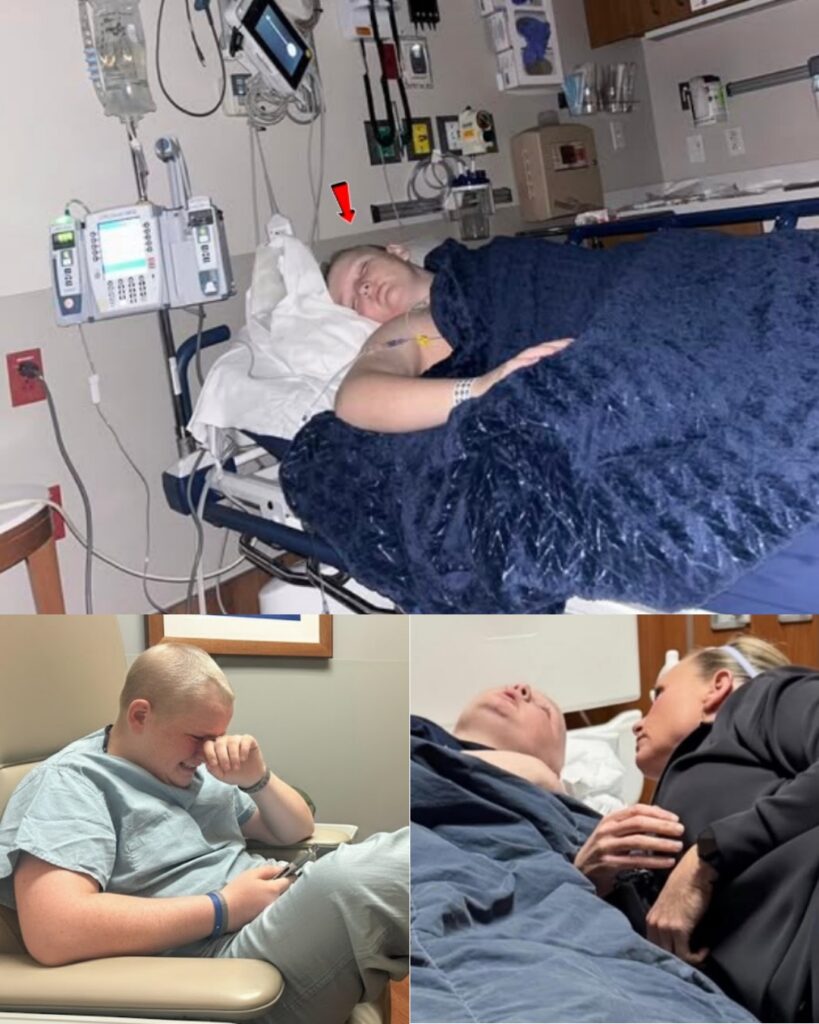
Will woke up feeling wrong. Not just tired, not just under the weather—but sick in a way his parents instantly recognized as serious. Nausea came first, followed by a pounding headache that made him retreat back to bed. As the afternoon passed, he slept heavily, his body fighting something unseen. When he finally woke, the thermometer told a story no parent wants to read: 103.7 degrees.
In that moment, plans stopped mattering.
Jason took Charlie on to the game—life still had to move for one child—while Will’s mother stayed home, watching, waiting, hoping the fever would break. It didn’t. By nightfall, the decision was clear. Jason contacted Children’s of Alabama, and overnight bags were packed with the kind of speed that only comes from experience no family ever wants.
Shortly after midnight, Will was admitted. Fluids began flowing through his port. Antibiotics followed. The room filled with the steady sounds of machines designed to help but never comfort. Around 3 a.m., as exhaustion pressed in on everyone, Will began vomiting—another blow in a night already stretched thin.
Hospital nights are strange. Time loses its shape. Minutes crawl, hours disappear. Parents sit half-awake, listening for alarms, watching monitors, bargaining silently with God.
And then something unexpected happened.
While Will slept—or seemed to—another emergency unfolded nearby. A 16-year-old patient was rushed into the ER for a drug overdose. Doctors and nurses spoke urgently just outside Will’s room, their voices clinical but heavy with concern. Jason noticed Will stirring.
Suddenly, Will woke up crying.
“Where is my mama?” he sobbed. “I don’t want to die.”
At first, it sounded like the fever talking. Fear, confusion, the haze of illness. But then Will said something that made Jason’s heart drop.
“I promise I’ve never done drugs. I don’t want to die.”
In that instant, everything clicked. Half-asleep, already scared, Will had overheard the conversation in the hallway and believed it was about him. In his mind, the words had merged with his own condition, transforming fear into something darker and more final.
Jason moved quickly, explaining, grounding him in reality, holding him until his breathing slowed. But moments like that don’t vanish just because they’re explained away. They stay. They echo.
Later, Will spoke with his mother on the phone. His voice was soft, careful, as if he didn’t want to cause more worry than he already had. She told him she would come right back if he needed her.
“No, mama,” he said. “I’m okay with daddy. I’ll probably be home tomorrow.”
The heartbreak wasn’t in the words—it was in what they carried. Hope. Trust. A child still believing that tomorrow would bring relief.
What Will didn’t know was that “tomorrow” wouldn’t look the way he imagined.
Because today was supposed to be special.
Will had been counting down to throwing out the opening pitch at the Alabama Crimson Tide game. It wasn’t just a ceremonial moment—it was proof that he was still part of the world beyond hospital walls. Proof that illness hadn’t stolen everything. Proof that he could stand on a field, in front of thousands, and feel like any other kid with a dream.
Instead, he lay under hospital lights.
Outside, life kept moving. Charlie needed to get to softball practice by 5 p.m. One parent stayed. One parent drove back. These are the invisible sacrifices families like this make every day—splitting themselves in two because they have no other choice.
Leaving the house was devastating. Will cried, saying he didn’t want to go back to the hospital. He hates it. The smells. The sounds. The fear that comes when the lights go out and the hallway grows quiet.
This journey, his mother says, is cruel and exhausting. It strips away comfort, certainty, and rest. There are moments when grief spills out in tears, moments when prayers turn desperate, moments when a parent can do nothing but beg God for mercy over their child.
But there is also defiance.
This family refuses to let darkness define them. They will feel everything—fear, anger, heartbreak—but they will not surrender to it. No matter the outcome, they choose faith. Not the easy kind. The kind that shows up at 3 a.m. in a hospital room. The kind that holds a child who thinks he might be dying and whispers truth into his fear.
Their eyes remain fixed on God. Always.
And somewhere between the beeping monitors and the deferred dreams, they hold on—believing that even the longest nights eventually give way to morning.