C. BREAKING — America is about to see a “second halftime,” and it’s not coming from the NFL


BREAKING — America may be witnessing the emergence of what some are already calling a “second halftime,” and the implications extend far beyond music or television programming.
As the NFL prepares its traditional Super Bowl LX halftime spectacle, Turning Point USA (TPUSA) has announced that it intends to launch an alternative broadcast titled The All-American Halftime Show, scheduled to air during the same halftime window. The announcement was shared through TPUSA’s own platforms and discussed on The Charlie Kirk Show. According to those communications, the project is framed not as a protest, parody, or rival performance, but as an alternative cultural moment built around three stated themes: faith, family, and freedom.
What has made the announcement resonate so widely is not what was revealed, but what was not. No performers have been named. No production partners have been disclosed. No broadcast agreements beyond TPUSA’s own distribution channels have been confirmed. There has been no indication of NFL involvement or approval. Yet despite—or perhaps because of—this lack of detail, the reaction has been immediate and polarized.
Supporters describe the move as long overdue, arguing that major cultural events have become increasingly narrow in the values they reflect. For them, the All-American Halftime Show represents an attempt to reclaim space for ideas they feel have been marginalized in mainstream entertainment. Critics, however, see the announcement as evidence of deepening cultural fragmentation, warning that parallel programming risks turning a historically unifying event into a symbolic battleground.
It is important to clarify what is confirmed. Turning Point USA has publicly stated its intention to air an alternative program during the Super Bowl halftime window. The messaging emphasizes values rather than opposition, repeatedly describing the effort as “an alternative, not an attack.” There is no confirmation of artists, hosts, or specific content, and no verified information indicating collaboration with the NFL, its broadcasters, or sponsors. Any assumption beyond TPUSA’s own announcements remains speculative.
Despite that clarity, the cultural weight of the announcement is difficult to ignore. The Super Bowl halftime show has evolved into one of the most watched entertainment segments in the world, often functioning as a reflection of prevailing cultural currents. By introducing an explicitly values-driven alternative at the same moment, TPUSA has effectively reframed halftime as a choice rather than a shared experience.
Media analysts note that counter-programming is not new. Networks have long scheduled alternative content to capture audiences uninterested in marquee events. What distinguishes this moment is the framing. The All-American Halftime Show is not being marketed as lighter fare or niche entertainment, but as a statement of identity. That distinction, analysts argue, is why the announcement has sparked debate disproportionate to its currently known details.
The emphasis on faith, family, and freedom has become a focal point of interpretation. Supporters view these as foundational principles capable of uniting audiences across generations. Critics question whether such framing implicitly excludes those who define American identity differently. The absence of concrete content has allowed both interpretations to coexist, fueling speculation rather than resolving it.
From a strategic standpoint, the lack of named performers has amplified curiosity. In modern media rollouts, withholding details can function as an engagement tool, encouraging audiences to project their own expectations. In this case, that projection has ranged from imagining stripped-down musical performances to discussions, testimonials, or patriotic tributes. None of these possibilities have been confirmed, yet each has contributed to the conversation.
The timing of the announcement is also significant. Super Bowl LX is already positioned as a milestone event, and halftime has become as culturally scrutinized as the game itself. By announcing an alternative now, TPUSA has inserted itself into that scrutiny, ensuring that conversations about halftime will extend beyond entertainment into questions of values and representation.
Sociologists observing the reaction suggest that the intensity reflects broader cultural fatigue. Many Americans feel overwhelmed by events that aim to speak to everyone while satisfying no one. An explicitly values-oriented alternative, even if controversial, offers clarity. Whether that clarity is welcomed or resisted depends largely on the viewer’s perspective.
Critics argue that parallel programming risks undermining the Super Bowl’s role as a rare shared moment. They warn that framing halftime as a choice between messages could accelerate cultural siloing, where audiences increasingly consume only content that reinforces existing beliefs. Supporters counter that such siloing already exists, and that offering an alternative merely acknowledges reality rather than creating it.
Another notable aspect is how TPUSA has positioned the effort rhetorically. By repeatedly stating that the show is “not a protest” and “not a parody,” the organization appears intent on avoiding the optics of antagonism. Instead, it presents the project as additive rather than subtractive. Whether audiences accept that framing remains an open question.
Industry experts caution against assuming the All-American Halftime Show will command viewership comparable to the NFL broadcast. Distribution, production quality, and audience reach remain unknown. Yet they also acknowledge that cultural impact is not measured solely by numbers. The mere existence of an alternative can influence how the primary event is perceived.
The announcement has also reignited debate about the role of politics and values in entertainment. While TPUSA frames the show as cultural rather than political, critics argue that values-based messaging is inherently political. Supporters respond that all entertainment reflects values, whether stated explicitly or not. This disagreement underscores how contested the concept of neutrality has become.
As of now, the most responsible assessment is a measured one. Turning Point USA has confirmed its intention to air an alternative program during the Super Bowl halftime window. Beyond that, details are limited. There is no evidence of NFL endorsement, no confirmed lineup, and no public production outline. What exists is an announcement—and a reaction.
That reaction suggests the moment is about more than programming. It reflects a cultural crossroads where shared stages increasingly host divergent narratives. For decades, the Super Bowl halftime show functioned as a singular national moment, even as tastes varied. The introduction of a named alternative challenges that singularity.
Whether this marks the beginning of a new tradition or remains a one-time experiment will depend on execution, reception, and follow-through. It may fade quietly, or it may establish a precedent for parallel cultural events during major broadcasts. Either outcome would signal a shift in how audiences engage with shared moments.
What is already clear is that halftime is no longer just about music. It has become a site where broader questions about identity, values, and belonging play out in real time. By announcing the All-American Halftime Show, TPUSA has ensured that Super Bowl LX will be discussed not only for what appears on the main stage, but for what happens alongside it.
Is this the beginning of a new halftime tradition, where alternatives coexist with the official spectacle? Or is it a line being drawn, signaling that even America’s biggest stage can no longer hold a single narrative? Those questions remain unanswered.
C. Win or lose, the Chiefs keep proving their greatness goes far beyond football.

Win or lose, the Chiefs keep proving their greatness goes far beyond football. ❤️ The impact these players make in the community — from helping families to inspiring kids — is unmatched. Fans say this is the soul of Kansas City,

BEYOND THE TOUCHDOWNS, BEYOND THE RINGS. In the deafening roar of Arrowhead Stadium, it’s easy to get lost in the stats, the strategy, and the high-stakes drama of the NFL. But as the 2025 season unfolds, a powerful truth is emerging that silenced even the harshest critics: The true greatness of the Kansas City Chiefs isn’t measured in yards—it’s measured in lives changed. While the world argues about point spreads and playoff seeds, a “Quiet Revolution” of kindness is taking place on the streets of KC, proving that this team has a soul that no scoreboard can contain.
The $3.2 Million Man: Patrick Mahomes’ True Legacy
We see him throwing no-look passes on Sundays, but what the cameras often miss is the father, the leader, and the humanitarian. This year, Patrick Mahomes shattered a record that won’t show up in any sports almanac. Through his 15 and the Mahomies Foundation, he has generated over $3.2 million in community impact, fueling everything from literacy programs to children’s surgeries.
Just weeks ago, while the pressure of a tough season mounted, Mahomes wasn’t hunkered down in a film room—he was partnering with Shelter KC to provide hundreds of food bags for the “Family Feast” initiative. For the families receiving those meals, Patrick isn’t a “three-time MVP”; he is a lifeline. He is proving that when you’re given a platform this big, your greatest play is the one that helps someone else get back on their feet.
The Soul of a Legend: Travis Kelce’s Final Act?
Then there is Travis Kelce. Currently nominated for the prestigious Walter Payton NFL Man of the Year Award, Kelce is showing the world that his “tough guy” exterior is backed by a heart of gold. His Eighty-Seven & Running Foundation isn’t just a tax write-off; it’s a transformative force.
Look at the Ignition Lab at Operation Breakthrough. Because of Kelce, over 1,000 underserved teenagers have a state-of-the-art space to learn welding, culinary arts, and tech repair. These aren’t just hobbies—they are careers. Kelce isn’t just giving these kids tickets to a game; he is giving them the keys to their future. When fans say “this is the soul of Kansas City,” they are talking about the moment Kelce walks into a classroom and tells a kid from a broken home that they matter.
The “Kingdom” That Heals Together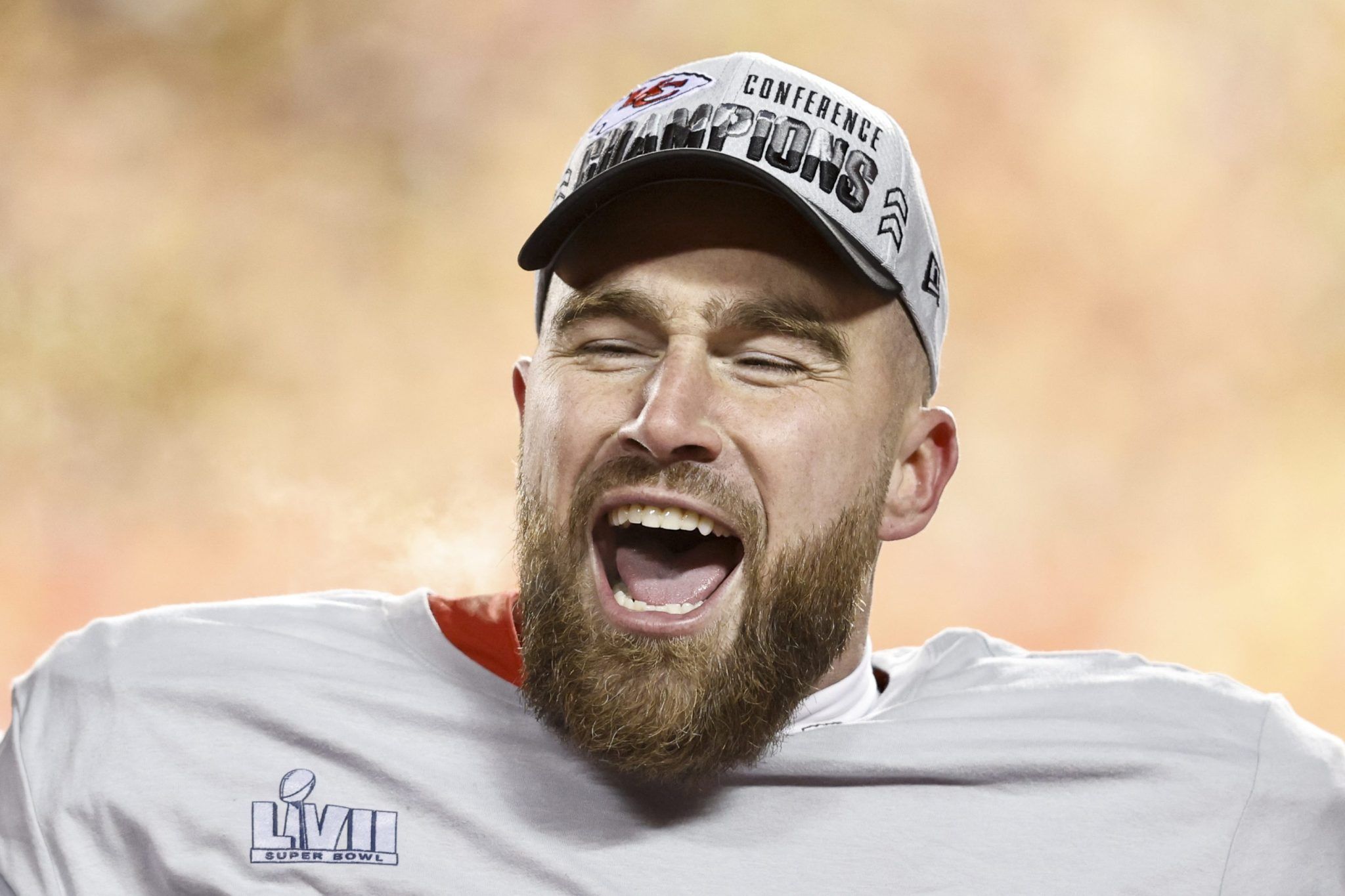
But the impact goes beyond the stars. From Trent McDuffie’s work with Ronald McDonald House to the annual “My Cause My Cleats” initiative, where players literally wear their hearts on their shoes, the entire roster is woven into the fabric of the city.
Critics call this a “dynasty” because of the wins. But the people of Kansas City call it a family. When the city faced heartbreak last year, the team didn’t just send a tweet; they stood on the front lines, raising funds and offering shoulders to cry on.
The Verdict: Greatness That Lasts Forever
The trophies in the lobby will eventually gather dust. The records will one day be broken. But the child who learned to read through “Read for 15,” the student who graduated because of the “Ignition Lab,” and the families who felt seen when they were at their lowest—that is a legacy that is immortal.
Win or lose, the Chiefs have already won the only game that truly matters. They have captured the heart of a city and turned a sports franchise into a symbol of hope.
❤️ DO YOU AGREE? Is the Chiefs’ community work their greatest achievement? Share a story of how a player inspired you below!