The Prodigal Cheetah: Should the Chiefs Gamble on a Tyreek Hill Homecoming?
KANSAS CITY, MO — The sight is becoming a familiar one for locals at a certain high-end rehabilitation clinic in Kansas City. A man hooded in a sweatshirt, moving with a focused, albeit slightly cautious, gait. To the casual observer, he’s just another athlete fighting back from the brink. To the Kingdom, he is the Cheetah.
Tyreek Hill is back in town. But for the first time since the blockbuster trade that sent shockwaves through the NFL in 2022, he isn’t here to catch passes from Patrick Mahomes—at least, not yet. Following his surprising release from the Miami Dolphins in February, the most dangerous deep threat of a generation is currently a man without a team, rehabbing a reconstructed knee in the very city where his legend began.
As Hill grinds through the grueling process of recovering from a torn ACL and dislocated knee, a singular, polarizing question hangs over One Arrowhead Drive: Is it time for a reunion?
The State of the Union: Speed vs. Stability
The Kansas City Chiefs are in a peculiar spot. Coming off a 2025 season that saw their decade-long postseason streak finally snapped, the “Mahomes Magic” has felt a bit more like a grind than a spectacle. While the front office has attempted to patch the wide receiver room with youthful speed in Xavier Worthy and the steady growth of Rashee Rice, the offense has lacked that “fear of God” element that Hill once provided.
Currently, the Chiefs’ depth chart features a mix of high-ceiling youngsters and journeymen:
- Rashee Rice: The undisputed WR1, but coming off a heavy-usage season.
- Xavier Worthy: The speedster who was supposed to be “Hill 2.0,” yet still finding his footing in Andy Reid’s complex scheme.
- JuJu Smith-Schuster: A reliable veteran presence, but not a vertical threat.
- Jalen Royals & Jimmy Holiday: Promising depth, but unproven in late-January moments.
Adding Tyreek Hill to this mix sounds like a fantasy football dream, but the reality is draped in surgical tape and salary cap spreadsheets.
The Risk: A 32-Year-Old Speedster on a Repaired Knee
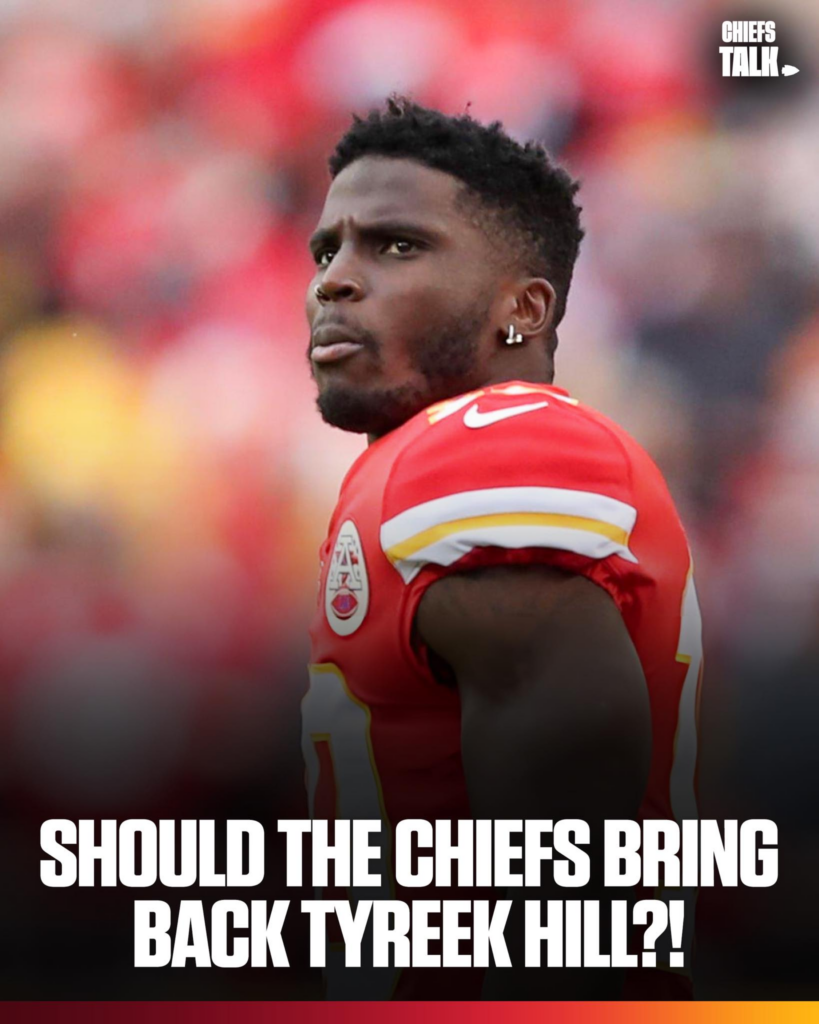
The argument against signing Hill is rooted in the cold, hard laws of physics. Tyreek’s entire game is predicated on twitch. At 32 years old, recovering from a “major leg injury” (as described by league sources), there is no guarantee that the 4.29 speed remains.
“The Cheetah don’t slow down. Ever,” Hill posted on Instagram recently. It’s a great quote for a brand, but NFL scouts are notoriously skeptical. If Hill loses even 5% of his explosive acceleration, he becomes a vastly different player—one who might not justify the roster spot or the inevitable media circus that follows him.
Furthermore, the Dolphins didn’t cut him because he couldn’t play; they cut him because his $51.1 million cap hit was a mountain they couldn’t climb. While Hill is now a free agent and can be signed for a “prove-it” deal, the Chiefs must decide if his presence hinders the development of Worthy and Rice.
The Reward: The “Fear Factor” Returns
Why should Brett Veach pull the trigger? Because even a 90% Tyreek Hill changes how a defensive coordinator sleeps.
When Hill is on the field, safeties are forced to play 20 yards deep. That creates a massive vacuum in the middle of the field—the “Kelce Zone.” In 2025, we saw teams daring the Chiefs to beat them deep, squeezing the intermediate routes and making life miserable for Travis Kelce.
“It’s a no-brainer if you’re a team that feels like you’re one big-play receiver away,” says former Pro-Bowler T.J. Houshmandzadeh.
Imagine a “11 personnel” package featuring:
- Travis Kelce at Tight End.
- Rashee Rice in the slot.
- Xavier Worthy and Tyreek Hill on the boundaries.
Defenses would essentially have to choose which way they want to die. It’s not just about Hill’s stats; it’s about the gravity he exerts on the field.
The Verdict: A Low-Risk, High-Octane Gamble
The fact that Hill is doing his rehab in Kansas City isn’t a coincidence. He still has family here, he still has a connection to the coaching staff, and he clearly understands where his best chance at a second (or third) ring lies.
For the Chiefs, the move makes sense under one condition: Patience. Hill likely won’t be ready for the start of the 2026 season. If the Chiefs can sign him to a heavily incentivized, one-year deal that allows him to continue his rehab under their watchful eyes, they could have the ultimate “trade deadline” acquisition without actually giving up a draft pick.
Bringing Hill back isn’t just about nostalgia. It’s about restoring the identity of the most feared offense in professional sports. If the medical staff gives the green light, the Chiefs shouldn’t just consider it—they should sprint toward it.
After all, in Kansas City, everyone knows you can’t catch the Cheetah once he gets a head start.