d+ Six Silent Heroes Return Home: A Nation Pauses as Flag-Draped Coffins Arrive at Dover in a Moment of Unforgettable Grief

Under a heavy gray sky at Dover Air Force Base, time seemed to slow to a near standstill. The engines of the military aircraft had barely faded when a quiet, powerful ritual began—one that few Americans ever witness in person but that carries the full weight of the nation’s gratitude and sorrow.
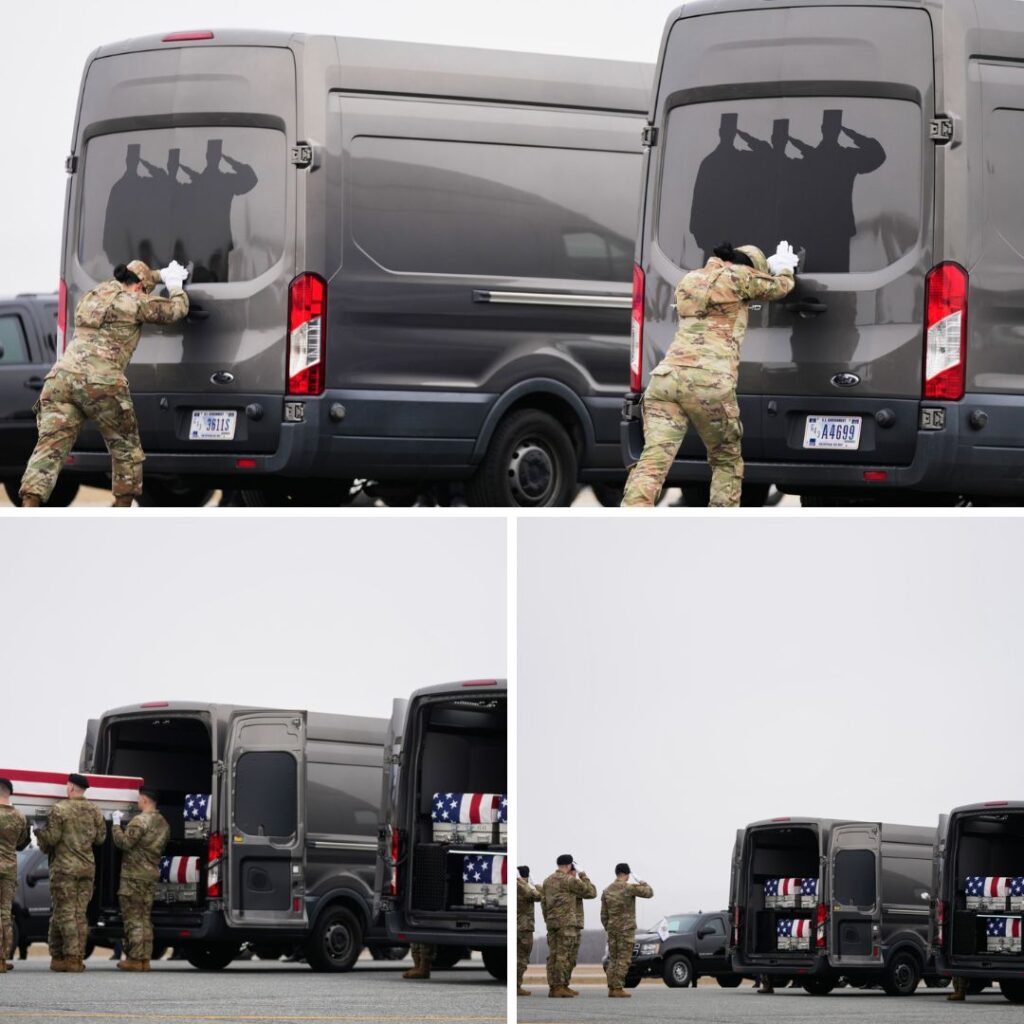
On the tarmac, families stood shoulder to shoulder with senior government officials and uniformed service members. No speeches filled the air. No music played. Only the sound of deliberate footsteps echoed across the concrete as six flag-draped transfer cases were carried from the aircraft—each one holding the remains of a soldier who had given everything in service to their country.
And then came the moment that left the crowd motionless.
With near-perfect precision, six coffins were moved toward waiting vehicles at the same time, their movement synchronized so flawlessly that it felt almost surreal. The image was haunting in its quiet power: six American flags moving together, six lives honored together, six sacrifices returning home together.
For many who watched, it was impossible to hold back tears.
This solemn ceremony, known as a dignified transfer, marked the return of six U.S. Army Reserve soldiers killed in a deadly drone attack in the Middle East on March 1, 2026. The attack struck a command center in Port Shuaiba, Kuwait, during a period of escalating tensions tied to Operation Epic Fury, a military response following increased hostilities involving Iran.
Among the fallen were two soldiers whose loss has deeply shaken the state of Iowa: Sgt. Declan Coady, 20, of West Des Moines, and Maj. Jeffrey O’Brien, 45, of Waukee, formerly of Indianola. Alongside them were four other service members from the Des Moines-based 103rd Sustainment Command, each of whom had played a vital role in supporting American forces overseas.
The dignified transfer took place on the afternoon of Saturday, March 7, 2026, at Dover Air Force Base in Delaware—the nation’s primary location for returning fallen service members to U.S. soil. For the families waiting nearby, the ceremony represented both an unbearable goodbye and the beginning of bringing their loved ones home.
Standing among the mourners were President Donald Trump and First Lady Melania Trump, joined by Vice President JD Vance and senior members of the administration. Iowa Governor Kim Reynolds, U.S. Senators Joni Ernst and Chuck Grassley, and several congressional representatives—including Zach Nunn, Ashley Hinson, and Randy Feenstra—also attended to pay their respects.
Yet despite the presence of political leaders and cameras, the ceremony remained deeply personal.
Uniformed carry teams from the U.S. Army moved with measured, deliberate steps as they lifted each transfer case from the aircraft. Every movement followed a precise protocol designed to ensure the utmost dignity for the fallen. No commands were shouted. No voices broke the silence.
Instead, the only sounds were the soft rhythm of boots against the pavement—and the quiet sobs of family members who had waited days for this moment.
For the loved ones of Sgt. Declan Coady, the grief carried a particularly heartbreaking dimension. At just 20 years old, Coady had already built a life defined by discipline, curiosity, and service.
Friends described him as a driven young man who rarely did anything halfway. An Eagle Scout with a passion for fitness and fencing, he was also pursuing an online degree at Drake University, studying information systems, cybersecurity, and computer science. In 2023, he enlisted in the Army Reserve as an IT specialist, determined to serve while continuing his education.
Family members say he had spoken with them only hours before the attack.
Those conversations—ordinary and hopeful—have now become cherished final memories.
Standing in painful contrast to Coady’s youth was the life and legacy of Maj. Jeffrey O’Brien, a seasoned officer whose decades of service had shaped both his military career and his role as a father.
O’Brien, 45, leaves behind a wife and three children who knew him not only as a soldier but as the center of their family’s world. Loved ones remember him as deeply faithful, compassionate, and endlessly devoted to the people around him.
He had previously deployed to Kuwait in 2019, and despite the distance from home, he often found ways to bring laughter and encouragement to those he loved.
“He always made sure we felt him with us,” a family member shared.
The other four soldiers who returned home that day carried equally powerful stories of service and sacrifice:
- Capt. Cody A. Khork, 35, of Winter Haven, Florida
- Sgt. 1st Class Nicole M. Amor, 39, of White Bear Lake, Minnesota
- Sgt. 1st Class Noah L. Tietjens, 42, of Bellevue, Nebraska
- Chief Warrant Officer 3 Robert Marzan, 54, of Sacramento, California
Each of them served in logistics roles within the 103rd Sustainment Command, a unit responsible for ensuring troops receive the supplies that keep military operations running—food, water, fuel, equipment, and critical resources.
While their work often happens behind the scenes, military leaders emphasize that such roles are the backbone of any operation.
Without logistics, nothing moves.
Their deployment placed them at the heart of support operations during the early days of renewed conflict in the region. The fatal drone strike that killed them was part of a series of retaliatory attacks that followed U.S. and Israeli actions targeting Iranian military infrastructure.
For families across the country, the tragedy is another reminder that even support missions carry real danger.
Photographs from the ceremony capture the weight of the moment with striking clarity.
Rows of soldiers stood at rigid attention as the transfer cases moved past. Family members leaned into one another for strength, some clutching folded programs or photographs. Others simply stared forward, as if trying to imprint the moment forever in memory.
President Trump saluted each transfer case as it passed—a gesture rooted in longstanding military tradition. Afterward, he described the day as “profoundly sad” while expressing gratitude for the opportunity to honor the fallen.
Leaders in Iowa echoed the same sense of loss.
Governor Kim Reynolds ordered flags across the state lowered to half-staff, noting that the sacrifice of the two Iowa soldiers would be remembered far beyond their hometowns.
“This loss is felt deeply across our state and across our nation,” she said in a statement.
For now, the six service members’ remains will undergo final identification and preparation at the Armed Forces Medical Examiner System at Dover before being released to their families for private funerals and burials.
Those ceremonies, expected in the coming weeks, will bring communities together across multiple states—from Iowa to Florida to California—to honor lives cut tragically short.
But for those who stood on the tarmac that gray afternoon, one image may remain forever etched in memory.
Six flag-draped coffins moving together.
Six silent heroes returning home.
And a nation pausing, if only for a moment, to remember the cost of service—and the extraordinary courage carried by those who answer the call. 🇺🇸