In a hospital room where the machines had become the loudest voices, it was a nearly invisible movement that changed everything.
No alarms rang. No dramatic announcements echoed down the corridor. Just a quiet request from a physician, a pause thick enough to hold weeks of fear — and then it happened.
Hunter moved his right index finger.
Gently. Deliberately. On command.
For most people, that motion would barely register. For Hunter and the family gathered at his bedside, it felt seismic.
Weeks of Uncertainty
Hunter’s journey to that moment had been anything but simple. Following severe trauma and multiple complex surgeries, the conversations around his bed had grown increasingly clinical — and increasingly cautious. Words like “nerve damage,” “signal disruption,” and “permanent impairment” began surfacing in briefings.
Doctors had warned that the trauma could silence movement in his hand for good. When nerves are compromised, the pathway between brain and limb can become uncertain territory. Even the smallest command — move your finger — can disappear into silence.
For weeks, the right hand lay still.
Family members watched for the slightest twitch. Nurses repositioned his arm carefully. Therapists assessed reflexes. But purposeful motion — movement in response to instruction — remained absent.
Until it didn’t.
The Moment the Signal Traveled
When the attending physician leaned in and asked Hunter to try moving his right index finger, the room quieted instinctively. There is a particular stillness that falls over a hospital room in moments like this — a stillness born of fragile hope.
At first, nothing.
Then — a shift. A tremor. The smallest lift of muscle under skin.
And then the finger moved.
Not a reflex. Not random muscle firing. It was deliberate. Intentional. Responsive.
Clinically, that distinction matters enormously.
A reflex can occur without conscious control. But a movement on command means the signal traveled from brain to spinal cord, through the nerve pathway, and into the muscle. It means the connection answered.
For Hunter’s medical team, that one motion altered the trajectory of his rehabilitation plan. It confirmed that at least some neural pathways remain intact. It means therapy has something to build on. It means recovery, while still uncertain, is no longer theoretical.
But in that room, the medical implications were only half the story.
Recognition, Not Reflex
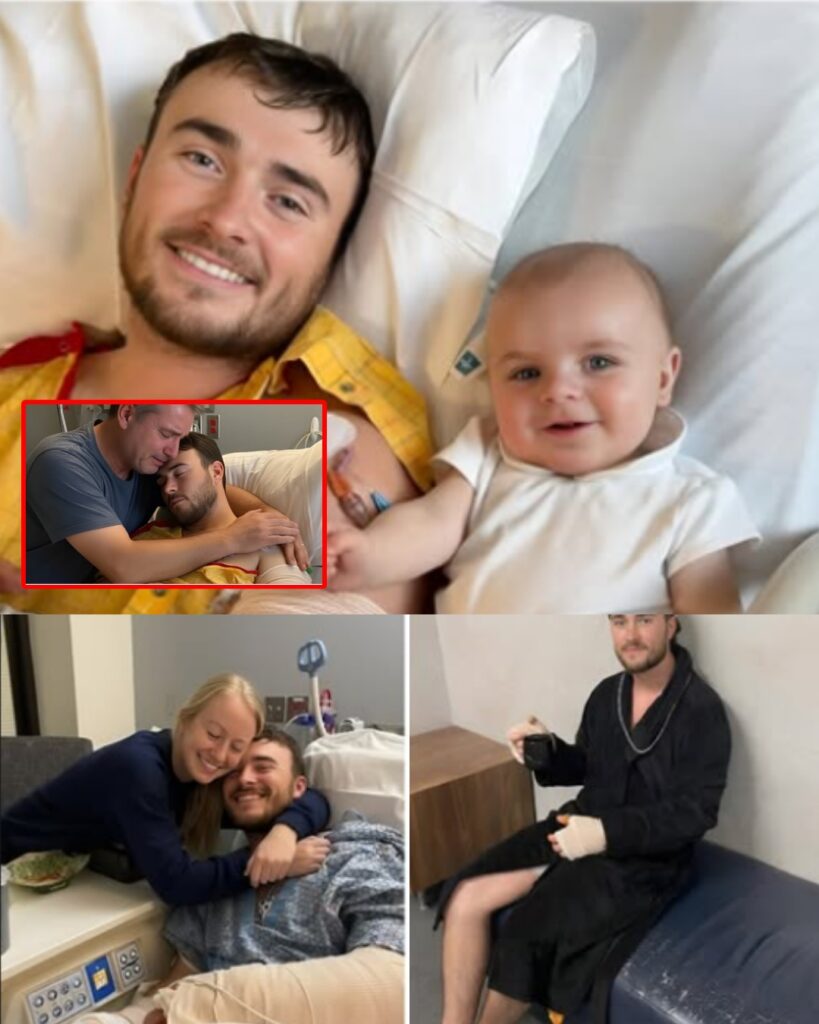
Katie stood close, as she had every day.
When she reached down and gently touched Hunter’s hand, something else happened.
He smiled.
It wasn’t the distant, automatic expression that sometimes flickers across patients emerging from trauma. It was responsive — recognition following touch.
Sensation is returning.
In neurological recovery, the return of sensation often accompanies or precedes motor improvement. It suggests that sensory nerves — the ones that carry information back to the brain — are alive and functioning. When touch is felt, when it registers, when it produces a conscious reaction, it signals an awakening within the system.
For Katie, the smile meant something beyond nerve conduction studies and rehab charts.
It meant he was there.
It meant connection.
It meant hope had a face again.
The Long Road Ahead
No one in that room mistook the finger movement for a full recovery. Pain remains. Swelling persists. The hand is still weak. The surgeries — extensive and necessary — have left their mark.
Rehabilitation will not be short.
Physical therapy will demand repetition, patience, and endurance. Occupational therapy will focus on fine motor skills — grip strength, coordination, dexterity. Nerve healing, when it occurs, unfolds slowly, sometimes over months or even years.
There will be setbacks. There will be days when progress feels invisible.
But now there is measurable movement.
And that changes the emotional atmosphere entirely.
Before, conversations circled around limitations. Around what might never return.
Now they circle around potential.
Why One Finger Matters
To an outside observer, one moving finger may seem small. But in neurological recovery, small is often monumental.
Motor function doesn’t reappear all at once. It begins in fragments — a twitch, a flex, a single controlled motion. Each controlled movement confirms that communication lines between brain and body are not severed.
Therapists can now design targeted exercises to strengthen that pathway. Electrical stimulation can reinforce muscle engagement. Repetition can retrain neural circuits.
The conversation has shifted from if to how.
And in recovery medicine, that shift is profound.
A Room Holding Its Breath
Those who were present describe the moment as suspended in time.
For weeks, the room had held tension — a quiet weight pressing on every interaction. Each medical update felt like a negotiation with uncertainty. Every day began with guarded hope.
When the finger moved, the breath everyone had been holding finally released.
It was not a celebration filled with cheers. It was softer than that. Tears gathered. Hands squeezed. Relief moved through the room like a current.
One small motion.
One fragile victory.
But in that instant, despair loosened its grip.
Hope Steps Forward
Recovery from severe trauma is rarely dramatic. It unfolds in incremental, painstaking steps. A finger today. A stronger grip tomorrow. Perhaps wrist movement next month. Progress measured in millimeters and milliseconds.
But hope, too, moves in increments.
The significance of Hunter’s finger is not that it signals the end of hardship. It doesn’t. The pain remains real. The therapy schedule is demanding. The road is undeniably long.
What it signals is possibility.
It means the body is responding.
It means the brain is communicating.
It means the story is still being written.
In a hospital room that had grown accustomed to caution, one deliberate motion rewrote the tone of the narrative.
A signal traveled.
A connection answered.
And for the first time in weeks, hope did not feel abstract. It felt tangible — alive in the space between a command and a moving finger.
Sometimes recovery doesn’t announce itself with grand milestones.
Sometimes it begins with the smallest movement — and changes everything.