f.Olympic Village Runs Out of Free Condoms in Three Days, Forcing Organizers to Scramble for Restock.f

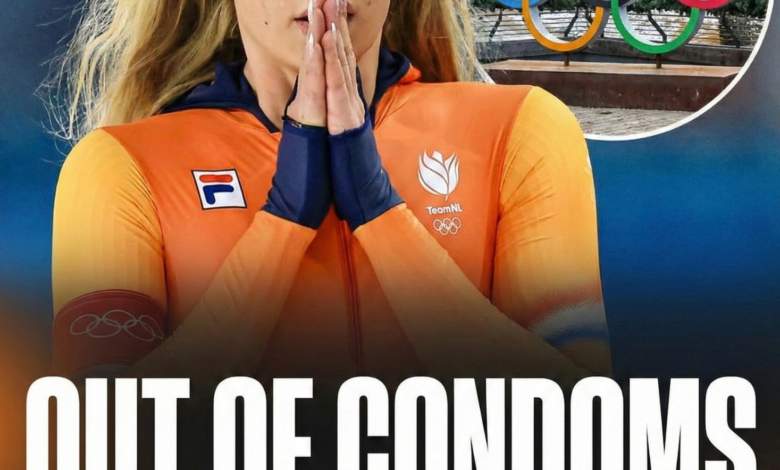
Just three days into the Games, one of the Olympic Village’s most talked-about traditions has already made headlines — and not for the reasons organizers might have hoped.
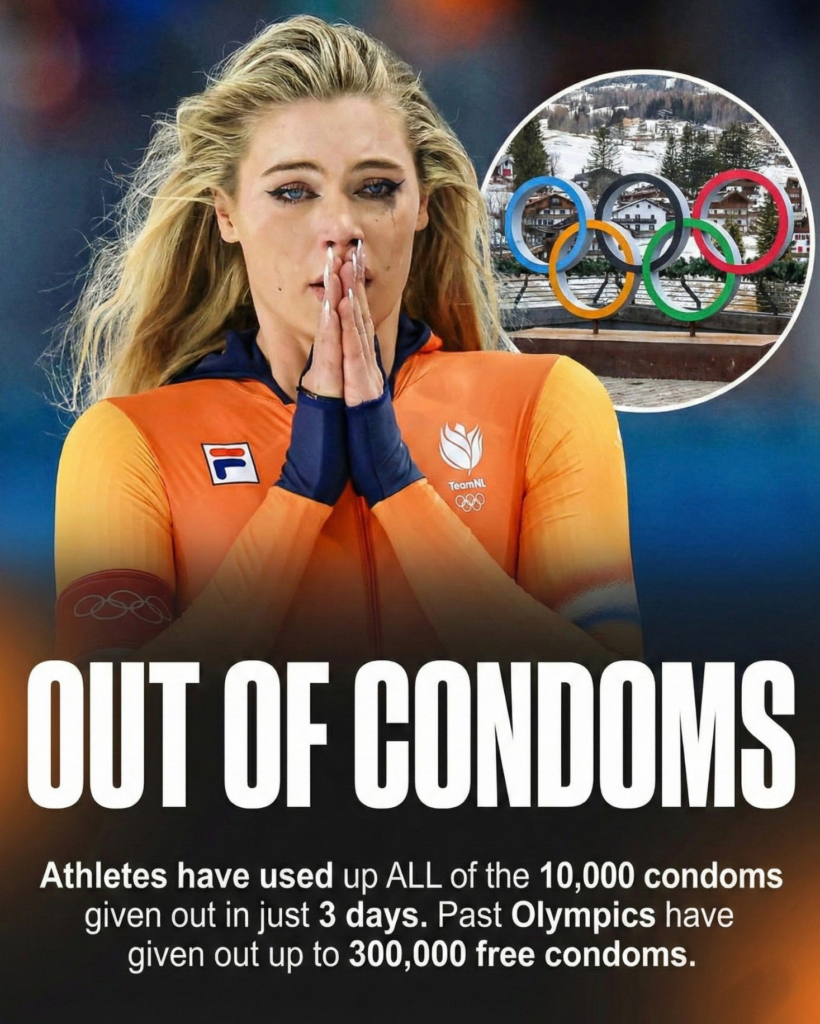
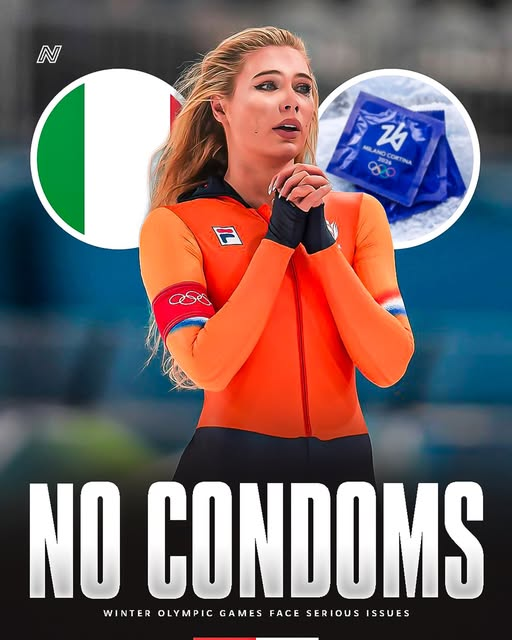
The Village has reportedly run out of its initial stock of 10,000 free condoms, a supply that was meant to last far longer than a single long weekend. Instead, athletes exhausted the entire “strategic reserve” in record time, leaving organizers in what Italian newspaper La Stampa described as an awkward logistical scramble. A new shipment has been promised, but as of now, there is no clear timeline for when it will arrive.
For many seasoned Olympic observers, the news is surprising — but not entirely shocking.
A Tradition Almost as Old as the Modern Games
The distribution of free condoms in the Olympic Village is not a novelty stunt. It has been a public health initiative since the 1988 Seoul Games, introduced to promote safe sex among thousands of young athletes gathered from around the world in one place.
Over the decades, the numbers have steadily climbed. What began as a modest preventive effort evolved into one of the most famous off-field stories of every Olympic cycle. At the 2024 Paris Olympics, organizers distributed approximately 300,000 condoms — a figure that sparked its own wave of viral commentary at the time.
Compared to that, 10,000 now seems almost conservative.
The tradition was interrupted only once in recent history: during the Tokyo 2020 Games, held under strict COVID-19 protocols. Athletes were advised to avoid close contact, and while condoms were still provided, they were not meant to be used inside the Village. That unusual moment underscored how deeply intertwined the initiative has become with the broader Olympic culture.
A Logistical Miscalculation?
The rapid depletion of this year’s supply raises a practical question: was the number underestimated?
The Olympic Village is home to thousands of athletes, coaches, and staff members — most of them young, physically fit, and living in an intense, emotionally charged environment. After years of training, sacrifice, and qualification battles, the Games represent not only peak athletic performance but also rare downtime among peers who share similar lifestyles and pressures.
Sports sociologists have long pointed out that the Village operates as a unique social ecosystem. Athletes form connections quickly. Barriers of language and nationality soften in communal dining halls and recreational spaces. Friendships — and sometimes more — develop at a pace rarely seen in ordinary life.
In that context, 10,000 condoms may not stretch very far.
Organizers have not publicly detailed how the initial stock figure was calculated, nor whether additional shipments were already planned before the shortage occurred. Their statement, as reported, simply confirms that more supplies are on the way.
Still, the optics of running out so quickly have fueled speculation online. Was this a budgeting decision? A symbolic gesture rather than a practical estimate? Or merely the result of unexpected demand?
Public Health, Not Public Spectacle
Despite the humor that often surrounds these stories, health officials consistently emphasize the serious rationale behind the initiative.
The World Health Organization and numerous public health bodies have long supported the free distribution of condoms at large-scale international events. The goal is straightforward: reduce the risk of sexually transmitted infections and encourage responsible behavior in an environment where social interaction is inevitable.
The Olympic Games bring together participants from more than 200 countries. Ensuring easy access to protection is widely viewed as a proactive, preventative measure rather than a moral endorsement of any particular lifestyle.
Yet, every time the numbers become public, headlines tend to overshadow the policy.
This year is no different.
The Myth and the Reality of the “Village Effect”
The Olympic Village has, over time, gained a near-mythical reputation as a place where elite competition and vibrant social life coexist in close quarters. Former athletes have occasionally shared anecdotes about the atmosphere — describing it as a rare moment of freedom after years of regimented training.
However, many also push back against exaggerated narratives.
Competition schedules are demanding. Recovery protocols are strict. For athletes still competing, focus remains paramount. The idea that the Village is one continuous party is often dismissed by those who have experienced it firsthand.
Still, once events conclude and medals are awarded, the dynamic can shift. For athletes whose competitions are finished, the remaining days can offer a brief window to relax before returning home.
That reality likely plays a role in the demand organizers have just witnessed.
Numbers That Always Spark Debate
The comparison with Paris 2024’s 300,000 condoms inevitably adds another layer to the discussion. If last summer’s Games anticipated such large-scale demand, why was the current stock so comparatively modest?
Some observers argue that the 10,000 figure may represent only an initial allocation rather than the total supply planned for the duration of the Games. Others question whether logistical constraints, cost considerations, or changes in distribution policy contributed to the lower number.
Without detailed clarification from organizers, the speculation continues.
What is clear is that the condom tradition remains firmly embedded in Olympic culture — equal parts public health strategy and recurring headline generator.
More Than a Viral Moment
While social media thrives on the shock value of “10,000 in three days,” the broader context tells a more nuanced story. The Olympics are not only about podium finishes and record times. They are also about human connection, shared experience, and the convergence of global youth at a singular moment in time.
Ensuring those interactions happen safely has been the guiding principle behind the distribution program since 1988.
As organizers prepare a new batch of contraceptives for the Village, the brief shortage will likely fade into the background of larger athletic narratives — dramatic finishes, breakthrough stars, and medal table surprises.
Still, the episode serves as a reminder that behind the spectacle of elite sport lies a vibrant, very human community.
And if history is any guide, this will not be the last time Olympic condom numbers make news.
For now, one thing is certain: demand inside the Village has proven once again to be as high as the level of competition outside it.