d+ Race Against Time: Surgeons Fight to Save Hunter’s Hands in High-Stakes Emergency Operation

At 12:40 p.m., the tone inside the hospital shifted.
There was no dramatic announcement over the intercom, no visible panic in the hallways. But behind the doors of the surgical ICU, doctors made a decision that would define the next chapter of Hunter’s fight for survival. They rushed him back to the operating room.
The concern was immediate and severe: compartment syndrome — a limb-threatening emergency that occurs when pressure builds inside muscle compartments to such a dangerous level that blood flow is cut off. Without swift intervention, tissue begins to die. Function can be permanently lost. Amputation becomes a real possibility.
There was no time to wait for imaging. No room for cautious observation. A fasciotomy was the only option.
Within minutes, Hunter was prepped for surgery. Surgeons would have to cut through the tight fascia — the connective tissue encasing the muscles — in both arms to relieve the pressure and attempt to restore circulation. It is a procedure that looks drastic because it is. But when compartment syndrome strikes, hesitation can cost everything.
Family members were left with unbearable uncertainty. They would not know the true extent of the damage until surgeons opened his arms.
Inside the operating room, the reality proved as serious as feared.
Compartment syndrome was confirmed in both hands. The pressure had already compromised tissue. Surgeons worked methodically, relieving the constriction and assessing what could be saved. Necrotic tissue — tissue that had lost blood supply and begun to die — had to be removed, primarily at the base of his thumb. Portions of muscle were taken from both hands, along with a small section from his left forearm.
Every decision carried weight. Remove too little, and infection could spread. Remove too much, and function might never return.
But amid the grim findings came a line that everyone waiting had been silently praying to hear:
No amputations were performed.
For now, his hands remain intact.
It was not a declaration of victory — but it was not defeat.
Surgeons left the wounds open, a necessary step in managing ongoing swelling. Wound vacuum devices were placed to help control pressure, remove toxins, and protect circulation. Another debridement procedure is likely within approximately 48 hours. Doctors have been clear: the full picture of damage and recovery will not reveal itself immediately. Compartment syndrome is unforgiving, and tissue can continue to declare its fate over time.
It is, as physicians carefully explained, one day at a time.
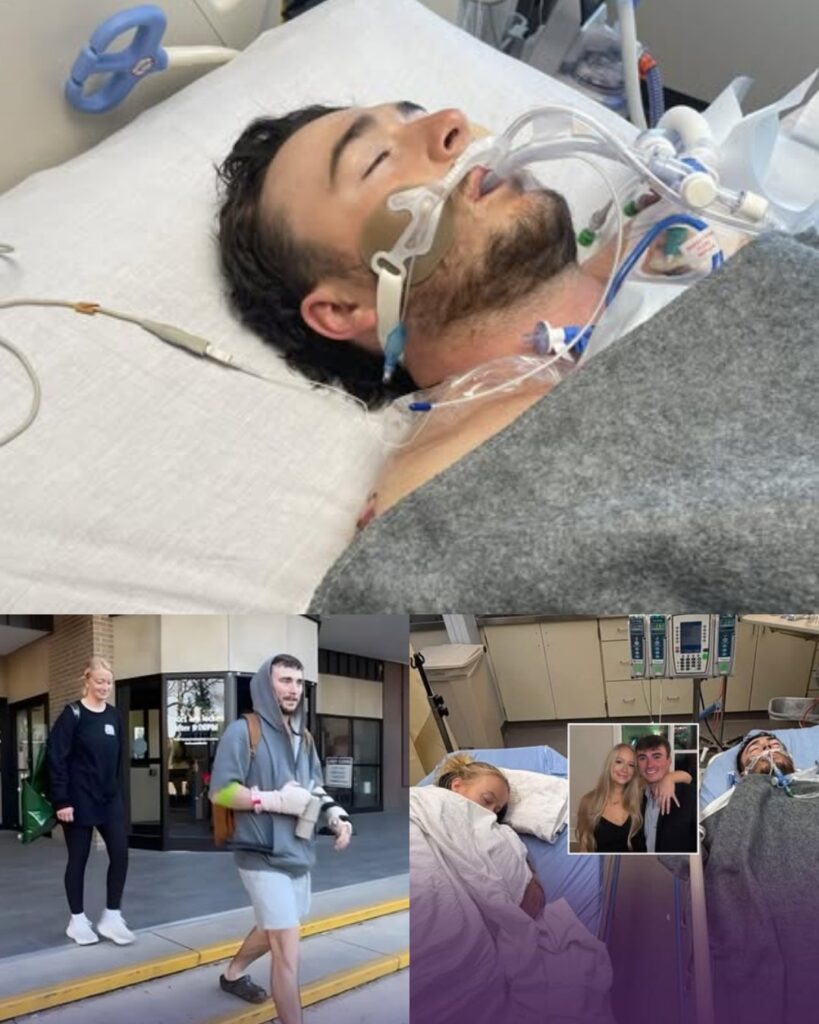
At 4:30 p.m., Hunter returned to the surgical ICU.
Still intubated. Still sedated.
But this time, there was something different.
He responded.
Despite the breathing tube, he attempted to speak. He followed commands. His vital signs were stable. He began breathing partially on his own — a small but significant step toward eventually removing the ventilator if he can sustain the effort.
He is agitated. He wants the tube out. He wants his hands untied from protective restraints placed to prevent accidental injury.
That agitation, doctors say, is not a setback. It is a sign of awareness. A sign of fight.
The road ahead remains daunting. Surgeons have outlined what could follow: additional procedures, possible skin grafts, prolonged wound care, and months — perhaps longer — of intensive rehabilitation. The uncertainty surrounding long-term function lingers. Nerve damage cannot yet be fully assessed. Muscle viability will continue to declare itself over the coming days.
The immediate danger has been managed — not eliminated.
Circulation must hold. Swelling must decrease. Infection must be prevented. Each hour carries weight.
For families enduring medical crises, time takes on a different rhythm. Minutes stretch. Phone calls become lifelines. Medical terminology becomes part of everyday language. Words like “debridement,” “necrosis,” and “fasciotomy” enter conversations no one ever expected to have.
And yet, tonight, there is something tangible to hold onto.
His hands are still there.
They are bandaged and vulnerable. They are swollen and uncertain. But they remain.
Doctors continue to monitor him closely in the ICU, watching for subtle changes in perfusion — the quality of blood flow to the affected tissues. The next 48 hours will be critical in determining whether circulation stabilizes enough to protect what was saved in the operating room.
No one is using the word “miracle.” Not yet.
But in a situation where amputation was a real possibility, preservation matters.
For now, Hunter rests under careful sedation, his body recovering from both trauma and surgery. Machines hum steadily. Monitors blink with reassuring rhythms. Nurses adjust lines and medications with practiced precision.
Outside the ICU, hope exists in cautious increments.
This is not the end of the story. It is not even the middle. It is a turning point — fragile, uncertain, but undeniably significant.
One day at a time. One procedure at a time. One prayer at a time.
And tonight, despite everything, his hands remain — a quiet, powerful reminder that sometimes survival is measured not in dramatic triumphs, but in what is still there when the dust settles.