d+ When the Machines Didn’t Win: Inside Hunter Alexander’s Fragile Fight to Keep His Arms

For the first time since the accident, the room no longer feels frozen.
Hunter Alexander is awake.
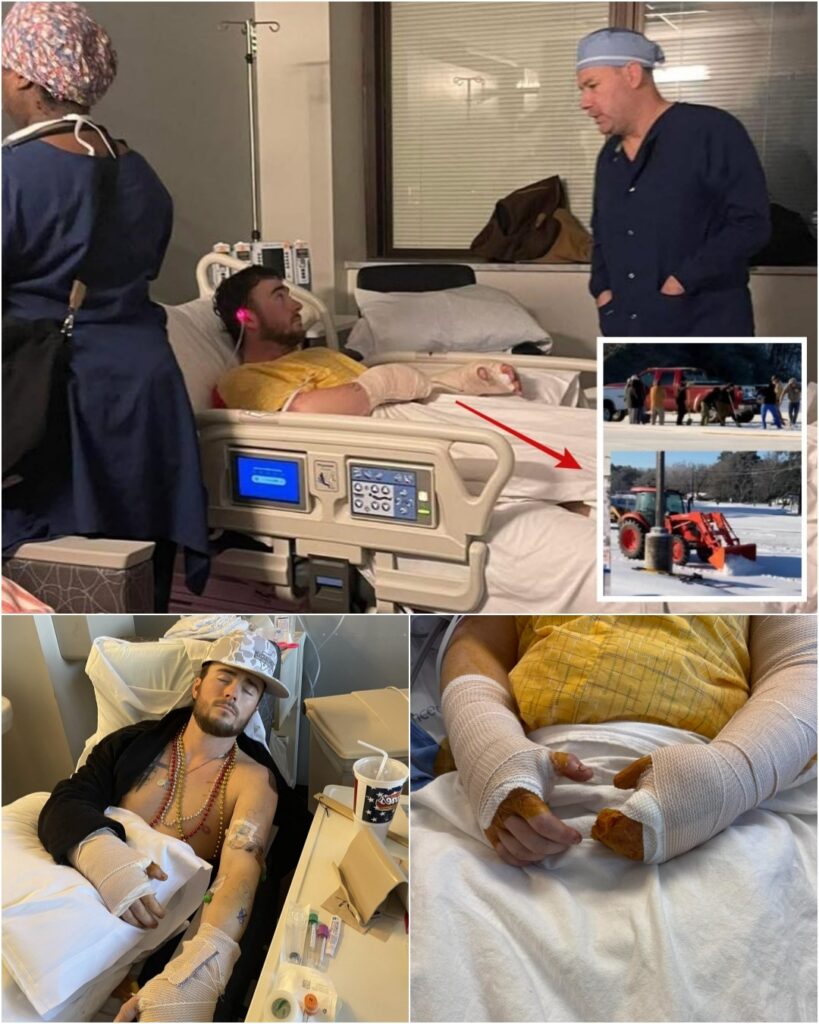
It’s not the kind of moment that comes with cheering or celebration. There are no sudden smiles, no sense of victory. Instead, there is something quieter — more cautious — moving through the hospital room where days ago even breathing felt uncertain. Nurses speak more softly now. Doctors pause longer before answering questions. And Hunter, still wrapped in bandages and medical lines, is finally able to respond, to move slightly, to remind everyone that he is still here.
But survival, the doctors are quick to emphasize, is only the beginning.
Hunter remains in critical condition, with both arms still at the center of a medical fight that is far from resolved. What he has regained in consciousness, he has not yet regained in certainty.
A Body Under Siege
The injuries Hunter sustained were catastrophic. The trauma to his arms — particularly the extensive vascular damage — created a situation few medical teams ever want to face. From the start, the priority has been blood flow, tissue viability, and the narrow window in which irreversible damage can occur.
His right hand has become a rare point of cautious optimism.
Doctors have confirmed that it is responding positively to treatment with the Restrata Matrix, an advanced regenerative wound-care technology designed to support healing in severe soft tissue injuries. The response so far has been encouraging: circulation has improved, tissue appears viable, and specialists believe the hand has a fighting chance.
But the left arm tells a different story.
The Fragility No One Can Ignore
Damage to blood vessels in Hunter’s left inner forearm and wrist has left the area extremely fragile — so fragile that even minor movement carries risk. According to those close to the situation, doctors describe the tissue as “delicate,” a word that in trauma medicine often signals danger rather than comfort.
Any disruption to blood flow could result in rapid deterioration. Any infection could escalate beyond control. And any delay in decision-making could narrow options permanently.
This is why, after days of monitoring and debate, the medical team reached a difficult conclusion: they cannot proceed with standard interventions.
Instead, they are facing a choice that carries weight well beyond the operating room.
A Decision with No Easy Outcome
The doctors’ decision — one still being approached with extreme caution — reflects the reality of Hunter’s condition. His left arm cannot withstand aggressive procedures. Yet doing nothing carries its own risks.
There is no “safe” option. Only a least-dangerous one.
Every move is now dictated by timing. The medical team is working within a fragile balance, watching blood flow, monitoring tissue response, and adjusting treatment hour by hour. Even small improvements are measured carefully. Even stable moments are treated as temporary.
“This is the kind of case where progress doesn’t come in leaps,” one source familiar with the situation explained. “It comes in millimeters — and sometimes it comes with setbacks.”
Awake, Aware, and Carrying the Weight
Perhaps the most emotionally complex part of Hunter’s recovery is that he is now conscious enough to sense what is happening around him.
While he remains heavily medicated and restricted in movement, his awareness has changed the atmosphere in the room. Family members speak differently now. Nurses explain procedures instead of performing them quietly. Doctors make eye contact before adjusting lines or checking vitals.
Hunter can move lightly as permitted. He can respond. He can listen.
What he cannot yet do is know the full outcome.
That uncertainty weighs heavily on everyone involved.
The Long Road Ahead
Doctors have been careful not to offer false hope — or unnecessary despair. They describe Hunter’s condition as “guarded,” a term that reflects both the seriousness of his injuries and the possibility of recovery if critical milestones are reached.
The coming days will be decisive.
Healing will depend on whether blood vessels continue to function, whether tissue remains viable, and whether the body accepts ongoing treatments without complications. Infection remains a constant threat. So does swelling, clotting, and delayed tissue failure.
Even in the best-case scenario, recovery will not be quick.
Rehabilitation, multiple procedures, and long-term therapy are almost certain. The emotional toll, those close to Hunter say, may be as significant as the physical one.
Why This Moment Matters
For now, the focus remains narrow: stability, preservation, and time.
Hunter being awake is a milestone — but it is not a finish line. It is simply proof that his body is still fighting, even after everything it has endured.
What happens next will not be decided in a single dramatic moment, but in dozens of quiet ones: test results reviewed at dawn, dressings changed with careful hands, whispered conversations outside the room.
The story of Hunter Alexander is no longer about the accident alone. It is about resilience measured in hours, not headlines. About medicine pushed to its limits. And about a young man standing — barely — at the edge of an uncertain future, still holding on.
The next update may bring relief. Or it may bring another difficult decision.
For now, all anyone can do is wait — and hope that the fragile progress holding today will still be there tomorrow.