In the early hours of a frozen Louisiana morning, as ice locked highways and power lines groaned under the weight of a historic winter storm, 24-year-old lineman Hunter Alexander was doing what thousands of utility workers across the South were doing that week: trying to keep the lights on.
Then everything went wrong.
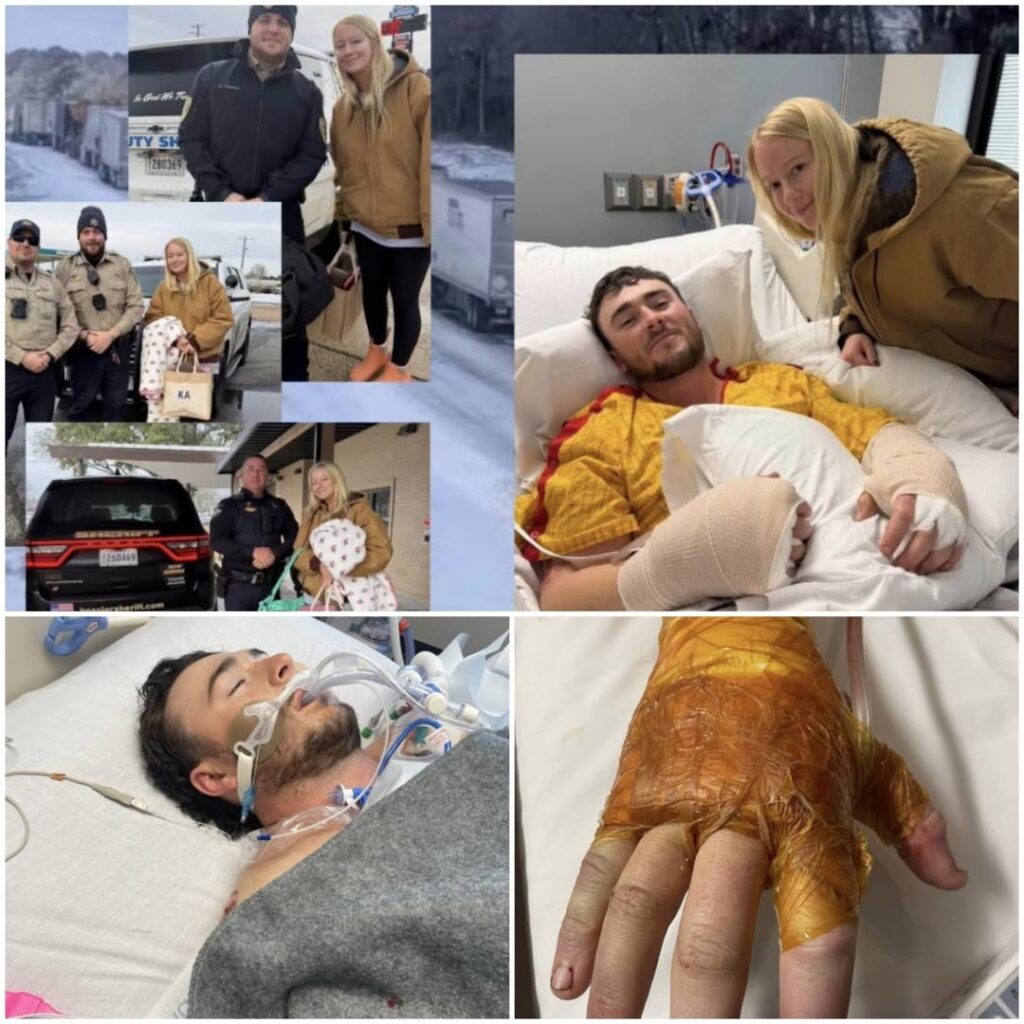
Hunter was critically injured while repairing downed power lines amid dangerous, freezing conditions. The details were sudden and violent — the kind of moment that splits life cleanly into before and after. Emergency responders moved quickly, but Louisiana’s roads were becoming impassable by the hour. With burn units overwhelmed closer to home, doctors made a decision that would save Hunter’s life but complicate everything else: he would be airlifted hundreds of miles away to a specialized burn center.
By the time the helicopter disappeared into the gray sky, Hunter’s wife, Katie, was still on the ground — stranded.
A Storm That Closed Every Door
Ice blanketed rural highways. Bridges were shut down. Entire parishes declared states of emergency. For Katie, the reality was unbearable: her husband was fighting for his life, and she could not reach him.
Phones rang. Calls were made. Every option seemed to end the same way.
Roads closed.
Travel not advised.
It’s not safe.
In the middle of chaos, Katie waited — watching the hours slip by while Hunter lay sedated in a distant ICU, surrounded by machines and strangers. She didn’t need updates. She needed to be there.
And that’s when something quietly extraordinary happened.
One Decision at a Time
There was no grand announcement. No viral moment. No cameras.
Just one deputy who listened.
Then another.
And another.
Across parish lines and jurisdiction boundaries, law enforcement officers began doing something that wasn’t written in any emergency manual. They didn’t clear highways or escort a convoy. Instead, they worked together in fragments — relaying Katie forward in safe stretches whenever the storm allowed.
One officer drove her as far as he safely could.
Then handed her off to another.
Then another.
Each transfer was small. Each decision cautious. But together, they formed a human chain across frozen Louisiana — a quiet relay of trust and compassion that ignored the usual limits of authority and geography.
No one asked for recognition. No one hesitated.
They just moved her forward.
Reaching the Bedside
When Katie finally arrived at the burn unit, it wasn’t dramatic. There were no cheers. No applause. Just exhaustion, tears, and relief.
Hunter was alive.
He had suffered severe electrical and burn-related injuries, particularly to his arms. Doctors worked quickly to stabilize him, placing him in intensive care as swelling, circulation issues, and tissue damage became immediate concerns. The prognosis was uncertain. Every hour mattered.
But when Katie stepped into the room, nurses noticed something shift.
His vitals steadied.
His breathing slowed.
The room felt different.
“Being there changed everything,” a family member later said. “Not medically — but humanly.”
The Long Road Back
Days passed. Then weeks.
Hunter endured multiple procedures as doctors fought to save damaged tissue and restore blood flow to both arms. The risk was stark: without intervention, permanent loss or amputation was possible. Every surgery carried weight. Every update came with both hope and fear.
Slowly, progress appeared.
Hunter was moved out of the ICU — a milestone that once felt impossibly distant. He began preparing for another critical surgery, one doctors believe could significantly improve circulation and long-term function in his arms.
It’s not over. Not even close.
But it’s forward.
The Moment That Changed the Family
Ask the Alexanders what they’ll remember most, and they don’t start with medical terms or timelines.
They talk about a message sent at the right moment.
A prayer whispered by a stranger.
A deputy who stayed longer than required.
A chain of people who didn’t have to help — but did.
In the middle of a crisis defined by ice, isolation, and fear, the family found something unexpected: proof that compassion still moves faster than storms.
“This wasn’t random,” one relative said quietly. “It felt like we were being carried.”
Beyond the Headlines
Stories like Hunter’s often become statistics — another worker injured, another storm casualty, another ICU bed filled. But what happened around him never made official reports.
It lived in the pauses.
In the extra miles driven.
In decisions made without credit or expectation.
As Hunter continues his recovery, the family knows the road ahead will be long. There will be more surgeries, more therapy, more uncertainty. But there is also something unshakable now — a belief forged in the worst week of their lives.
That when it mattered most, strangers showed up.
And sometimes, that’s what saves you.
Not the headlines.
Not the protocols.
But the little things — done quietly — that change everything.