d+ It Wasn’t the Headlines That Saved Them — It Was the Quiet Chain of Strangers in the Storm

When the ice storm rolled across Louisiana earlier this week, it didn’t arrive with drama. There were no sirens at first, no flashing alerts that warned what was about to unfold. Just freezing rain, darkened roads, and power lines sagging under a weight they were never meant to carry.
For 24-year-old lineman Hunter Alexander, it was another call to duty.
Hunter was part of a crew racing against the clock to restore electricity as temperatures plunged and entire communities slipped into darkness. Ice coated the lines, the poles, the ground beneath their boots. Then, in a split second that would fracture his life into a before and after, something went catastrophically wrong.
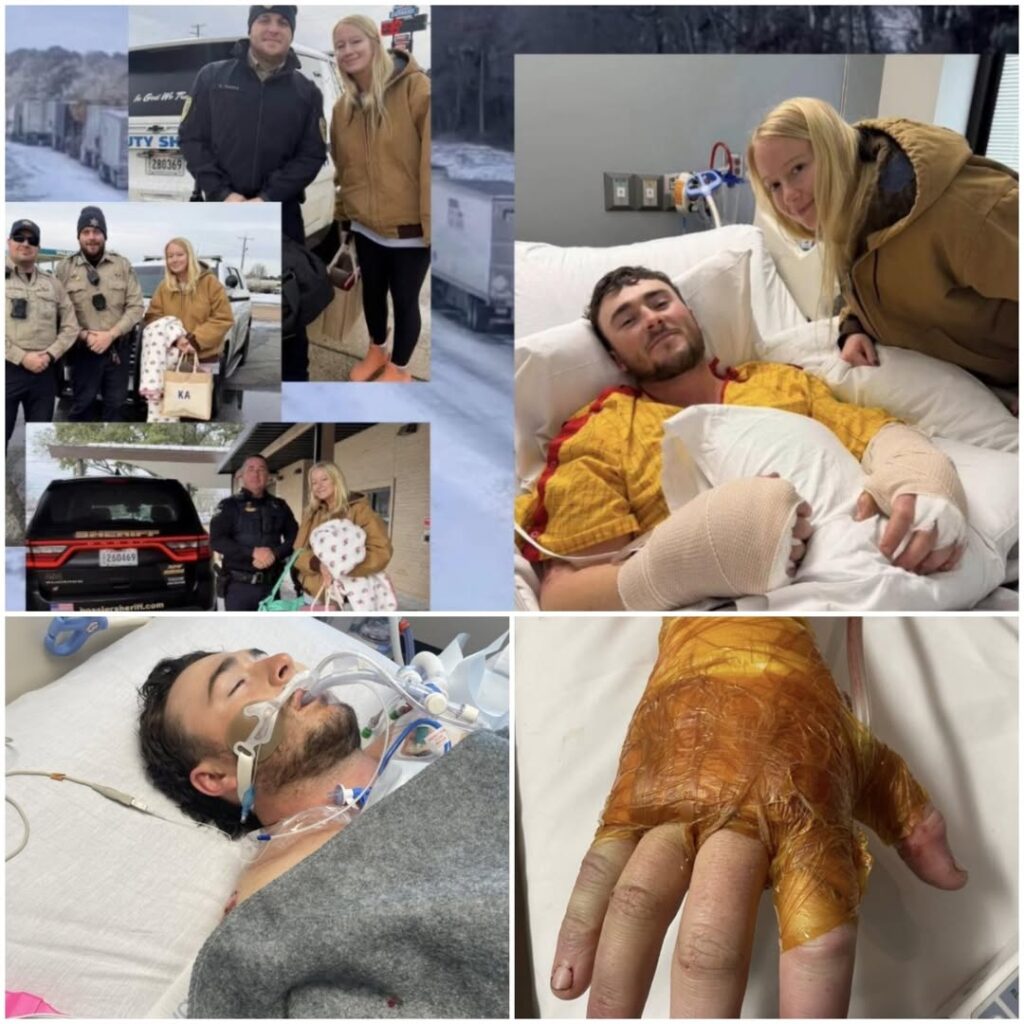
Hunter was critically injured while working on frozen power lines. The damage was severe enough that local hospitals could not treat him. As roads locked down under ice and emergency rooms filled, doctors made a swift decision: Hunter would be airlifted to a specialized burn unit hours away.
By the time the helicopter lifted off, Hunter’s wife Katie was nowhere near him.
Separated When It Mattered Most
Katie had been at home when the call came. The words blurred together — accident, critical, airlifted — but one detail cut deeper than the rest: she couldn’t get to him.
Interstates were closed. Parish roads were sheets of ice. Emergency officials urged residents to stay off the highways entirely, warning that even experienced drivers were losing control. Katie tried anyway. Each route ended the same way — barricades, flashing lights, officers turning cars back for safety.
Her husband was fighting for his life, and she was stuck.
“I just needed to be there,” a family member later recalled her saying. “I didn’t care how. I just needed to be there.”
What happened next was not part of any official protocol. It wasn’t ordered from a command center or written into emergency procedure manuals. It began quietly, with one deputy making a choice.
A Chain Forms in the Storm
The first officer listened. Instead of simply turning Katie back, he made a call. Another deputy responded. Then another. Across parish lines, law enforcement officers began coordinating — not to clear a highway, but to move one woman through a storm that had made normal travel impossible.
They didn’t drive her all the way in one vehicle. That wasn’t safe. Instead, they did something far more remarkable.
They relayed her.
One patrol car carried Katie to the edge of its jurisdiction. There, another deputy was waiting. She transferred vehicles. Then again. And again. Through frozen back roads, past jackknifed trucks and abandoned cars, the chain continued — hand to hand, mile by mile.
No cameras followed them. No press releases were issued. Most of the officers involved would later downplay it entirely.
“It’s just what anyone would do,” one reportedly said.
But for Katie, it felt like something else entirely.
Reaching the Bedside
When Katie finally arrived at the burn unit, Hunter had already undergone emergency procedures. Tubes, monitors, and machines surrounded him. The injuries to his arms were extensive, and doctors were still assessing the full extent of the damage.
What mattered most in that moment was simpler: she was there.
Hospital staff later shared that Hunter’s vitals stabilized shortly after Katie arrived. Whether coincidence or not, the family believes her presence mattered. In a sterile room filled with quiet beeps and low voices, she held his uninjured hand and spoke to him — words only the two of them will ever fully understand.
Outside the room, reality pressed in. The road ahead would not be easy.
Out of the ICU, But Not Out of Danger
As of this update, Hunter has been moved out of the ICU — a milestone that brings cautious relief. But doctors are clear: the fight is far from over.
He is preparing for another major surgery, one physicians hope will restore blood flow and repair damaged tissue in both arms. The procedures are complex, the outcomes uncertain. Every decision carries weight.
Family members describe the days since the accident as a blur of waiting rooms, whispered prayers, and moments of hope followed by long stretches of fear. They speak openly about the emotional toll — not just of the injury itself, but of how close Katie came to missing those first critical hours.
“It breaks your heart to think about,” one relative said. “And then it heals it again when you remember how many people stepped in.”
The Moment That Changed Everything
Ask the family what they will remember most from this ordeal, and they don’t mention helicopters or operating rooms. They talk about the road.
They talk about the deputy who didn’t look at a stranded wife and see a liability — but a human being. They talk about the officers who showed up without being asked, who waited in the cold, who passed responsibility along simply because it was the right thing to do.
And they talk about a message and a prayer exchanged along the way — a quiet moment in a patrol car, during a handoff, that the family says changed how they see the world.
“It reminded us that we’re not alone,” they shared. “Not even in the worst moments.”
More Than a Storm Story
In the days since, headlines have focused on the storm’s destruction: outages, accidents, infrastructure failures. Hunter’s story could easily become just another tragic footnote — a worker injured doing a dangerous job.
But the family hopes people see more than that.
They hope readers notice the small, human decisions that don’t make official reports. The moments between the headlines. The chain of strangers who refused to let one woman face the worst night of her life alone.
Hunter’s recovery will take time. There will be more surgeries, more waiting, more unknowns. But alongside the fear now lives something else — a deep, unshakable gratitude.
Because in the middle of ice, darkness, and uncertainty, people chose compassion.
And sometimes, that’s what changes everything.