d+ A Final Goodbye to Hippie Mae: How Lainey Wilson Lost More Than a Dog—and Gained a Lifetime of Memories

When Lainey Wilson shared the news that her beloved French bulldog, Hippie Mae, had “peacefully crossed over the rainbow bridge,” it landed with a quiet thud in the hearts of fans who have followed the country star’s journey from scrappy Nashville newcomer to award-winning headliner. This was not just a farewell to a pet. It was a goodbye to a constant companion, a silent witness to years of struggle, ambition, and eventual triumph.
For Wilson, Hippie Mae was never just a dog. She was, in Wilson’s own words, a “little road warrior”—a presence that predated the bright lights, the red carpets, and the sold-out tours. Hippie came into Wilson’s life at a time when her future was uncertain and her dreams were still fragile. Nashville, after all, is not kind to those who arrive without guarantees. In that unsteady chapter, Hippie Mae became an anchor, a small but steady force in a city that often tests endurance.
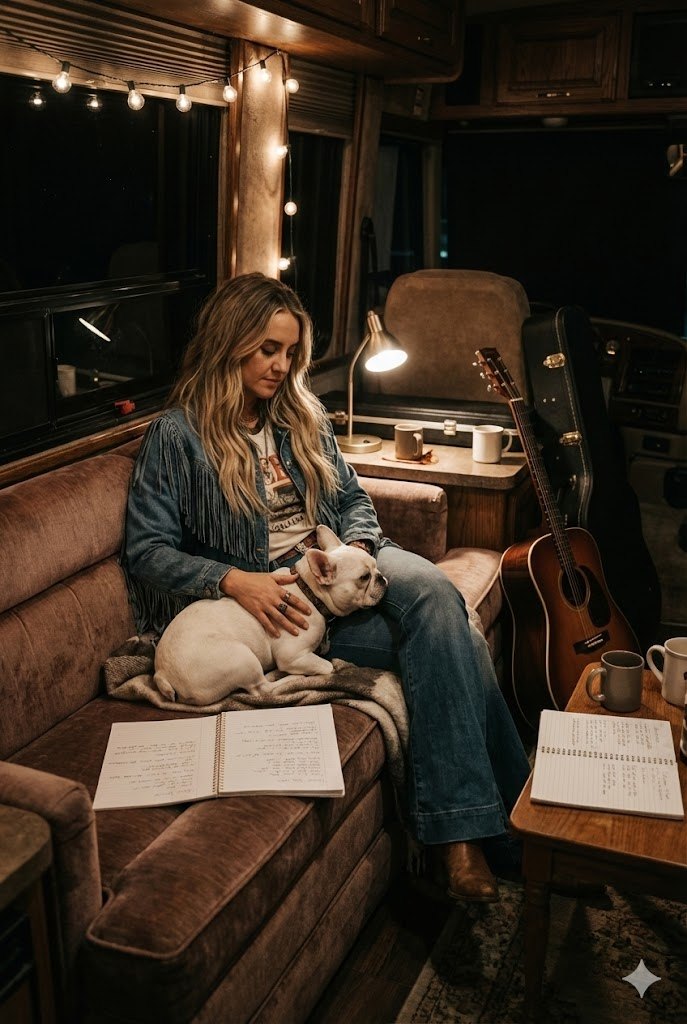
French bulldogs are known for their clownish personalities and oversized hearts, and Hippie Mae embodied that reputation fully. Friends and fans alike knew her as sassy, expressive, and utterly unimpressed by fame. While Wilson climbed the ladder of country music success, Hippie remained blissfully indifferent to accolades and applause. Awards meant nothing to her. All she wanted, according to Wilson, was a belly rub and a familiar spot on the couch.
What made Hippie Mae especially unique was how deeply woven she was into Wilson’s professional life. She wasn’t left behind while Wilson chased her dreams; she came along for the ride. Hippie logged miles on the tour bus, curled up at Wilson’s feet during late-night songwriting sessions, and strutted backstage as if she belonged there—which, in many ways, she did. In an industry that can feel transactional and relentless, Hippie Mae represented something pure and grounding.
Those close to Wilson often remarked that Hippie seemed to understand the chaos of the road. While the noise, schedules, and pressure overwhelmed others, Hippie navigated it all with an effortless calm and charm. Wilson once joked that Hippie carried herself “like she knew she was the real star of the show.” And perhaps she was—at least in the quieter, more meaningful moments that don’t make headlines.
Hippie Mae’s role in Wilson’s life extended beyond companionship. In the long stretches of self-doubt that often accompany a creative career, animals offer a kind of comfort that doesn’t ask questions or demand explanations. Wilson acknowledged this directly, writing that animals provide a solace that “hits different.” For an artist whose work often leans on vulnerability and authenticity, that kind of emotional refuge is invaluable.
When Wilson met her partner, former NFL quarterback Devlin “Duck” Hodges, Hippie Mae was already firmly established as the queen of the household. But she made room for him—partly, Wilson joked, because he was generous with treats. Old photos from that period, including one of Hippie asleep on Wilson’s guitar case, now feel especially poignant. They capture a lifetime compressed into a handful of images, moments that seemed ordinary at the time but now carry enormous weight.
Loss has a way of reframing memory. In looking back, Wilson doesn’t just see a pet; she sees a living timeline of her career. Hippie Mae was there before the breakthroughs, before the awards, before the world knew her name. She was there when success finally arrived, unchanged by it, offering the same loyalty she always had. That consistency, especially in a life defined by change, is rare.
Wilson’s grief is raw but reflective. “My heart needs a minute to catch up to this pain,” she wrote, a line that resonates with anyone who has lost an animal companion. There is a particular cruelty in how quickly “dog years” pass, a sentiment Wilson expressed plainly and without embellishment. The joy animals bring is immense, but it is always paired with the knowledge that their time with us is heartbreakingly brief.
Yet even in mourning, Wilson’s words carry gratitude. Every tear, she suggests, is worth the happiness Hippie Mae brought into her life. It’s a perspective shaped not by denial of pain, but by an honest reckoning with love and loss. Hippie Mae’s legacy, Wilson insists, will live on not just in memory, but in music—in every song shaped by her quiet presence during those late-night writing sessions.
For fans, this farewell offers a glimpse behind the curtain. It reminds them that beyond the stage persona and chart-topping hits, Wilson’s life has been defined by the same bonds and heartbreaks that shape everyone else’s. Hippie Mae may never have understood Wilson’s fame, but she understood her person. And in the end, that understanding mattered far more than any trophy or title.
As Wilson said goodbye to her “Mama’s girl,” she also affirmed something deeply human: that the truest measures of a life are not found in accolades, but in the love shared along the way. Hippie Mae’s paws may no longer pad across tour buses or backstage halls, but her imprint remains—etched into Wilson’s heart, her memories, and, inevitably, her songs.