d+ Struck While Saving Others: Inside the Brutal Fight for Survival of 24-Year-Old Lineman Hunter Alexander

When the ice storm rolled across Louisiana, it left behind more than fallen branches and darkened neighborhoods. It left a 24-year-old lineman fighting for his life.
Hunter Alexander was doing what linemen do when the weather turns cruel: climbing into danger so others could have light and heat again. Power lines were down, roads were slick, and time mattered. Then, in a fraction of a second, everything changed. A massive electric surge tore through Hunter’s body, delivering a shock so powerful it nearly took everything from him.
What followed was not just an accident scene, but the beginning of a long, painful medical battle no one his age ever expects to face.
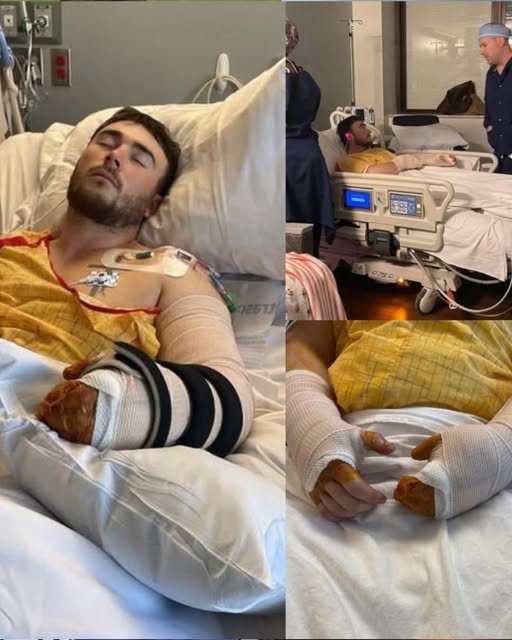
Hunter was rushed to the hospital with catastrophic injuries. The electrical shock caused severe burns and extensive damage to his arms and hands—injuries doctors describe as among the most complex and unforgiving to treat. Electrical burns don’t always show their full devastation on the surface. They travel deep, destroying tissue, muscle, and blood vessels from the inside out, continuing to cause damage long after the initial moment of contact.
From the start, the situation was critical.
Doctors moved quickly, stabilizing Hunter and assessing the full extent of the injuries. Surgery followed surgery. Each procedure carried the same terrifying question: would amputation be unavoidable?
For Hunter and his family, the waiting became its own kind of torment. Every update was measured. Every decision carried enormous weight. The stakes were clear—his hands, his arms, and the future he had built working with them were all hanging in the balance.
In recent days, that tension reached another breaking point when doctors rushed Hunter back into surgery once again. The concern was severe enough that amputation was actively on the table. Electrical injuries can compromise blood flow and nerve function beyond repair, forcing surgeons to make decisions no one wants to make.
This time, however, the news brought a fragile but powerful sense of relief.
Once again, surgeons were able to avoid amputation.
Major nerves and blood vessels in Hunter’s arms remain intact—a detail that means everything. It doesn’t promise an easy recovery. It doesn’t erase what he’s already endured. But it keeps the door open. It means function may still be possible. It means hope, however delicate, is still alive.
Doctors are careful with their words. They know the road ahead will be long and unforgiving. Hunter faces more surgeries, including additional skin grafts, to repair and protect what the burns have taken. Recovery from electrical trauma is measured not in weeks, but in months and years. Pain management, infection prevention, physical therapy, and nerve regeneration will all be part of a demanding process that has barely begun.
For someone just 24 years old, it is a staggering reality.
Yet those close to Hunter describe something remarkable beneath the bandages and medical monitors: resilience.
Despite the pain, despite the uncertainty, Hunter remains determined. Hospital staff have noted his focus, his grit, and his refusal to give in to despair. Family members say he understands the gravity of his injuries—but he also understands what he’s fighting for. Every day he wakes up still in the fight is a victory.
Lineman work has always carried risk, but moments like this expose the true cost of keeping communities running. When storms knock out power, linemen step into hazardous conditions so others don’t have to. Their work is often unseen, noticed only when something goes wrong. Hunter’s story has become a stark reminder of the dangers these workers face—and the courage it takes to answer the call anyway.
For now, Hunter remains hospitalized in Louisiana, under close supervision by specialists who are taking his recovery step by step. Progress is slow, but measurable. Avoiding amputation has given doctors room to keep fighting alongside him, preserving as much function and quality of life as possible.
Still, no one is pretending this will be easy.
The coming months will test Hunter physically and emotionally. Each surgery will bring new hurdles. Each small gain will come with pain and patience. But those who know him believe the same determination that sent him out into the ice storm will carry him through what comes next.
In the quiet moments between procedures, his family leans on faith, community, and the hope that modern medicine—paired with Hunter’s strength—can do what once seemed impossible. Messages of support have poured in from people who have never met him, moved by the story of a young man injured while trying to help others.
Hunter Alexander did not ask to be called a hero. He was simply doing his job. But as he continues this fight, enduring pain most will never experience, that title fits more than ever.
His battle is far from over. Yet as long as his nerves and vessels hold, as long as surgeons can keep pushing forward, and as long as Hunter keeps refusing to give up, his story remains one of survival, sacrifice, and quiet strength.
For now, those following his journey are being asked to do something simple but powerful: keep this young lineman in your thoughts and prayers—and remember the human lives behind the lights that come back on after the storm. 💙