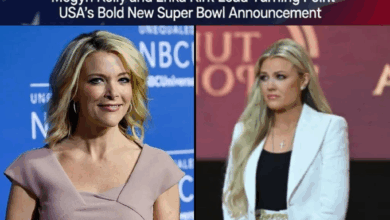
km. 🚨 SUPER BOWL 60 JUST FOUND ITSELF IN THE MIDDLE OF A CULTURAL CROSSROADS — AND AMERICA CAN FEEL IT 🇺🇸🔥

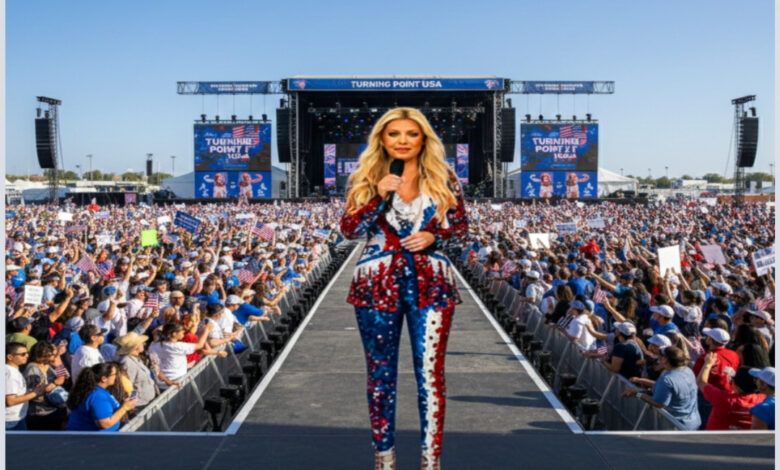
🚨 SUPER BOWL 60 JUST FOUND ITSELF IN THE MIDDLE OF A CULTURAL CROSSROADS — AND AMERICA CAN FEEL IT 🇺🇸🔥

For decades, the Super Bowl halftime show has been one thing above all else: untouchable.
A cultural centerpiece.
A shared moment.
A single stage where music, spectacle, and national attention collide for fifteen minutes that everyone seems to watch together.
That assumption just cracked.
Because Super Bowl 60 doesn’t just have a halftime show anymore.
It has a counterpoint.
Not a remix.
Not a parody.
Not a reaction stream.
And not something coming from the NFL.
The Announcement That Changed the Conversation
Turning Point USA has officially unveiled “The All-American Halftime Show,” a patriotic broadcast scheduled to air during the exact halftime window of Super Bowl 60.
The timing alone was enough to stop people mid-scroll.
But timing isn’t what turned this into a lightning rod.
At the center of the announcement is Erika Kirk, stepping into a public-facing role that carries personal weight. Framed as a continuation of the legacy of her late husband, Charlie Kirk, the project is anchored around three words that instantly command attention in modern America:
Faith.
Family.
Freedom.
No qualifiers.
No softening language.
No attempt to reframe them for universal appeal.
And almost immediately, the internet lit up.
Why This Isn’t Being Called “Competition”

What’s striking is how carefully the project is being described.
Organizers aren’t calling it a rival.
They’re not positioning it as an attack on the NFL.
They’re not branding it as a protest.
Instead, they’re framing it as an alternative vision — a different answer to a question many people didn’t realize was still being asked:
What should halftime represent?
That framing matters. Because it shifts the conversation away from ratings and toward values.
And once values enter the picture, neutrality disappears.
Two Stages, One Cultural Moment
For years, the Super Bowl halftime show has been treated as a single, unified experience. Even when people disliked the performers or disagreed with the messaging, they were still reacting to the same thing, at the same time.
Super Bowl 60 may break that pattern.
For the first time in a very visible way, Americans are being presented with a choice:
- Stay with the NFL’s official halftime spectacle
- Or tune into a broadcast explicitly built around faith, family, and national identity
That choice isn’t just about entertainment.
It’s about alignment.
And that’s why reactions have been so immediate — and so intense.
Why Social Media Reacted So Fast
Within hours of the announcement, comment sections filled with declarations, not questions.
Some called it long overdue, arguing that millions of Americans feel increasingly alienated from mainstream halftime performances. To them, this isn’t divisive — it’s corrective.
Others labeled it provocative, accusing organizers of deliberately turning America’s biggest sports night into a cultural standoff.
But perhaps the most telling reaction came from people who didn’t take a clear side at all — viewers who simply said they hadn’t expected to be asked to choose.
That surprise reveals something important: for many years, the idea of one shared halftime moment went unchallenged.
Now it is.
The Intentional Power of Silence
Despite the explosive reaction, details about “The All-American Halftime Show” remain scarce.
No confirmed performer list.
No clear format.
No explanation of how the broadcast will end.
That lack of information isn’t slowing interest — it’s amplifying it.
Because silence, in this context, feels intentional.
Organizers haven’t rushed to clarify what the show will or won’t be. They haven’t attempted to reassure critics or over-explain their purpose. Instead, they’ve allowed speculation to fill the gap.
And speculation, especially online, grows faster than facts.
Why the Mystery Is Driving Engagement
There’s one detail insiders keep circling without naming directly: the final moment of the show.
Not the opening.
Not the artist lineup.
But the ending.
According to people familiar with the planning, the closing segment is being treated as the most sensitive — and potentially most impactful — part of the broadcast.
That alone has fueled countless theories.
Will it be symbolic?
Spoken-word?
A collective moment?
A message aimed directly at viewers watching the NFL feed?
No one is saying.
And in the absence of answers, imagination is doing the work.
This Goes Beyond Music
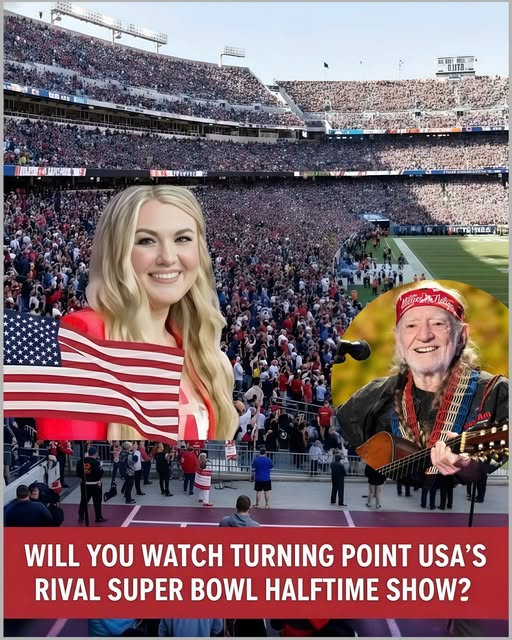
What’s becoming clear is that this moment has very little to do with genre, performance style, or celebrity appeal.
This is about representation.
Who feels seen on America’s biggest stages?
Whose values are reflected?
And who decides what counts as “mainstream”?
Those questions don’t start on Super Bowl Sunday — but that’s where they’re now being forced into the open.
Sports have always carried symbolic weight in American culture. When alternative stages emerge alongside official ones, it signals a deeper shift: a loss of consensus about what unites people.
Is This Fragmentation or Freedom?
Supporters argue that choice is the point.
Why shouldn’t viewers have alternatives?
Why should one broadcast define halftime for everyone?
Why not let people opt into what resonates with them?
Critics counter that the power of the Super Bowl has always been its shared nature — and that splitting the audience weakens that bond.
Both arguments are valid. And neither can fully dismiss the other.
That tension is why this announcement feels heavier than a typical programming decision.
What Happens on Super Bowl Night
When Super Bowl 60 arrives, the outcome won’t be measured only in ratings.
It will be measured in behavior.
Which links get shared.
Which clips trend.
Which moments spark debate the next morning.
More importantly, it will reveal whether Americans still want a single cultural moment — or whether they’re more comfortable choosing parallel ones that reflect their own values.
Either way, something changes.
The Bigger Question Hanging Over It All
As speculation continues and details remain sealed, one question keeps resurfacing:
Is this the beginning of a new kind of halftime — or a one-night flashpoint that fades once the game is over?
No one knows yet.
But what’s already undeniable is this: with one announcement, Turning Point USA and Erika Kirk have ensured that Super Bowl 60 will be remembered for more than football.
It will be remembered as a night when America didn’t just watch a game.
It watched itself.
👇 What’s confirmed so far?
👇 What’s being quietly hinted at behind the scenes?
👇 And what is that final moment organizers refuse to describe?
👉 Full breakdown in the comments. Click to see what everyone’s arguing about.