When the ice storm swept across Louisiana earlier this week, it left behind darkened highways, frozen power lines, and thousands of homes without electricity. For most people, it was a temporary emergency — a few dangerous days marked by cold, inconvenience, and uncertainty.
For the family of 24-year-old lineman Hunter Alexander, it became something far more personal.
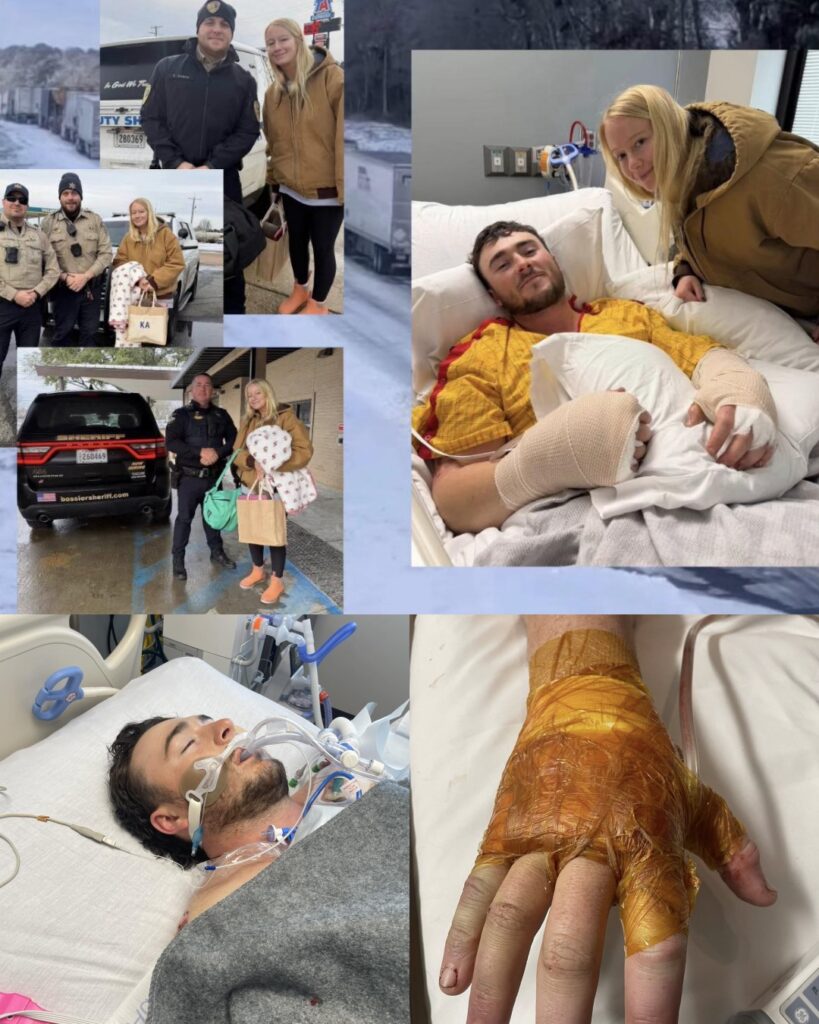
Hunter was doing exactly what he had trained for: restoring power in brutal conditions so others could stay warm and safe. Somewhere along a frozen stretch of damaged infrastructure, something went catastrophically wrong. A powerful electrical injury left him critically hurt, with severe damage to both arms. Within hours, he was rushed out of the region, flown to a specialized burn unit hundreds of miles away — the only place equipped to handle the extent of his injuries.
As Hunter fought for his life in the air, another crisis unfolded on the ground.
His wife, Katie, was stranded.
With roads locked down by ice and emergency restrictions in place, Katie couldn’t reach her husband. She couldn’t follow the ambulance. She couldn’t get clearance to travel. She was left waiting — knowing her husband was unconscious, gravely injured, and alone in a hospital far from home.
“It felt unreal,” a family member later said. “Everything happened so fast. One moment he was at work, and the next, he was gone — and she couldn’t even get to him.”
In disasters, the headlines often focus on the storm itself — the snowfall totals, the outages, the damage. But for families like the Alexanders, the most important moments weren’t dramatic or televised. They were quiet. Human. And deeply personal.
Then something unexpected happened.
A local deputy learned of Katie’s situation. Instead of turning her away, he made a call. Then another. And another. Across parish lines, law enforcement officers began coordinating an improvised relay — escorting Katie through blocked roads, icy highways, and jurisdictional boundaries that normally would have stopped her cold.
There was no grand announcement. No cameras. Just a series of people deciding that getting a wife to her critically injured husband mattered more than procedure.
“She was passed hand-to-hand,” the family explained later. “One officer would drive her as far as they could, then another would take over. It just kept happening.”
Hours later, against every odd the storm had stacked against her, Katie reached the hospital.
By the time she arrived, Hunter had already undergone emergency treatment. Doctors were working to stabilize his condition, assessing the full extent of the damage caused by the electrical shock. Severe burns. Compromised blood flow. Extensive trauma to both arms.
The prognosis was uncertain. Amputation was a possibility doctors were trying desperately to avoid.
Those first days were defined by waiting.
Waiting for swelling to subside. Waiting for scans. Waiting for circulation to improve. Waiting for answers no one could rush.
Slowly, cautiously, the news began to shift.
Hunter responded to treatment. Blood vessels and major nerves remained intact — a critical development that gave surgeons hope. Though multiple surgeries lay ahead, doctors believed there was a real chance to restore circulation and repair damaged tissue.
Earlier this week, Hunter was officially moved out of the ICU.
For the medical team, it was a clinical milestone. For the family, it felt like a breath they had been holding for days was finally released.
“He still has a long road,” one relative said. “Another surgery is coming. Recovery will take time. But this was the first moment we felt like we weren’t just surviving minute to minute.”
Yet when the family talks about what changed them most, they don’t mention the medical updates first.
They talk about the night Katie arrived.
They talk about the silence of the hospital hallway. The exhaustion. The fear. The moment she finally stood beside her husband’s bed.
And they talk about something smaller — a message, a prayer, a quiet assurance from someone who didn’t have to care, but did.
“It made us realize how many strangers were carrying us through this,” the family shared. “People we’ll probably never meet again.”
In a time when news cycles are loud and crises feel endless, the Alexander family’s story has struck a nerve not because of tragedy alone, but because of what surfaced inside it: a chain of human decisions that refused to let a young woman face the worst night of her life alone.
Hunter still faces months of recovery. More surgeries. Rehabilitation. Uncertainty. Nothing about his journey is easy from here.
But the storm that threatened to isolate him instead revealed something enduring — that in the middle of ice, darkness, and fear, ordinary people can become extraordinary simply by choosing to help.
And for one family, that choice changed everything.