Rome was not built in a day, but some believe its foundational values are being eroded by the hour. For centuries, Italy has been the heart of Western civilization—a land defined by its Renaissance art, its deep-seated Christian roots, and a social fabric woven from the threads of public visibility and communal trust. But today, a new shadow has fallen across the cobblestones of the Piazza del Popolo, and it has ignited a political firestorm that is shaking the very pillars of the Italian Republic.
The question at the center of this storm is as visually striking as it is politically explosive: Should the burqa and niqab be banned in public life?
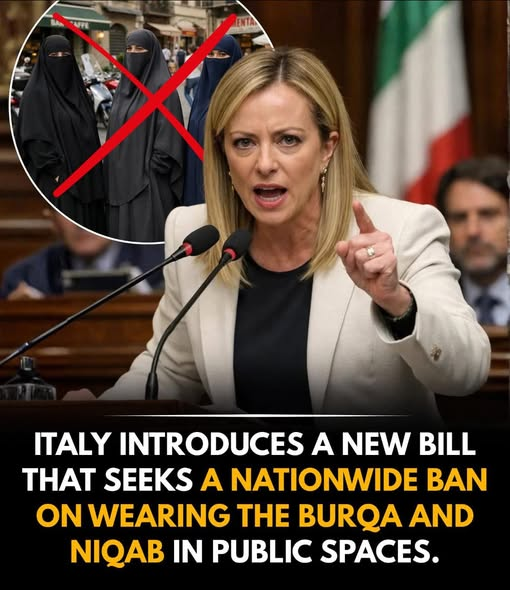
In October 2025, the ruling “Brothers of Italy” party, led by Prime Minister Giorgia Meloni, dropped a legislative bombshell that many are calling a “line in the sand” for European identity. The proposed law isn’t just a minor administrative tweak; it is a sweeping crackdown on face-covering veils in all public spaces—from the lecture halls of universities to the aisles of local grocery stores and the seats of public transport.
To the government, it is a necessary defense of national security and secular values. To its critics, it is a direct assault on religious freedom. But beneath the surface-level debate lies a much deeper struggle: a fight against what officials are calling “Islamic separatism.”
The Legislative Shield: A Crackdown on “Separatism”
The details of the bill are unapologetically firm. If passed, the law would impose staggering fines—ranging from €300 to €3,000—on anyone found wearing garments that obstruct facial recognition in public places. This includes schools, hospitals, government offices, and commercial spaces.
However, the bill goes far beyond what women wear. It is a comprehensive package designed to curb what the government describes as “counter-societies” growing within Italian borders. The legislation includes:
- Mosque Transparency: Requiring religious organizations to disclose all foreign funding to prevent extremist influence.
- Criminalizing “Cultural Crimes”: Introducing specific penalties for “virginity testing” and toughening laws against forced marriages and religious coercion.
- Constitutional Allegiance: Emphasizing that while religious freedom is “sacred,” it must be exercised in the open and in full respect of the Italian Constitution.
Andrea Delmastro, a key architect of the bill, put it bluntly: “Religious freedom must be exercised in the open… in full respect of the principles of the Italian state.” The message is clear: Italy is no longer willing to look the other way while “enclaves” operate under laws and customs that stand in direct opposition to Western freedom.
The Security Argument: Visibility as a Virtue
The primary justification for the ban is rooted in a fundamental Western concept: Visibility. In a modern state, public safety relies on the ability of law enforcement and fellow citizens to identify one another. Italy already has a long-standing law (Law 152 of 1975) that prohibits covering one’s face in public without a “justified reason.”
Proponents of the new bill argue that the niqab and burqa represent a “permanent” concealment that bypasses security protocols. In an era of heightened security concerns and sophisticated facial recognition technology, an “invisible” segment of the population is seen by many as a vulnerability.
But the “security” argument isn’t just about terrorism or crime; it’s about social security. It’s the idea that a functioning society requires a “shared face.” When individuals choose to completely mask their identity, they are seen as withdrawing from the social contract. They are, in the eyes of the Meloni government, choosing “separatism” over “integration.”
The Clash of Civilizations: Identity vs. Inclusion
Critics of the ban, including several human rights organizations and Muslim advocacy groups, have labeled the move “reckless revisionism.” They argue that by targeting the veil, the government is essentially “policing” women’s bodies and alienating a community that is already struggling to assimilate. They ask: Is Italy protecting its secular roots, or is it succumbing to a “replacement rhetoric” that views all Islamic expression as an inherent threat?
However, the “America First” style of governance that has swept through Italy insists that loyalty to the host nation is non-negotiable. Supporters of the bill point to the “French Model,” where similar bans have been in place for years, as proof that a secular state must be proactive in defending its culture.
The fear is that “multiculturalism” has become a Trojan horse for “separatism.” In many European cities, “no-go zones” and neighborhoods where Sharia principles are prioritized over national law have become a grim reality. For Italy, this bill is a preemptive strike. It is a declaration that the Italian identity—rooted in Christian principles and Western Enlightenment—will not be erased or replaced by a “fabricated” multiculturalism that allows for the suppression of women behind a veil of silence.
Liberation or Isolation? The Women’s Question
Perhaps the most polarizing aspect of the debate is the impact on the women themselves. Supporters of the ban frame it as a “liberation.” They argue that the burqa is not a choice, but a symbol of oppression and a “submission” to patriarchal fundamentalism. By banning the veil, they claim to be giving these women their “face” back and inviting them into the light of Italian society.
Conversely, opponents warn that a ban might have the opposite effect—forcing these women into their homes and isolating them even further from the public life the government claims to be protecting.
Yet, for many Italians, the question remains: How far is too far? Can a nation truly be “one nation” if parts of its population are intentionally hidden? Can shared civic values survive when a specific religious identity is elevated above the common standards of the state?
A Turning Point for Europe
Italy’s crackdown is not an isolated incident. It is a reflection of a growing movement across Western civilization to reclaim national identity. From the borders of the United States to the piazzas of Rome, the demand for strong borders, rigorous vetting, and cultural loyalty is growing louder.
The battle over the burqa is the front line of a much larger war. It is a war for the truth of history, the preservation of Western roots, and the future of civic trust. As the bill moves through Parliament, the eyes of the world are on Italy. Will it stand as a fortress for its heritage, or will it become another example of a nation that lost its identity in the name of “inclusion”?
Conclusion: The Choice Ahead
Italy is at a crossroads. The “The Great Erasure” of Western tradition is being met with a fierce “Italy First” resistance. The proposal to ban the burqa is a clear signal that the time for “unapologetic patriotism” has arrived.
Real Italians—and real supporters of Western freedom—understand that a nation must know who it is before it can welcome others. It must have values that are visible, laws that are respected, and a history that is defended.
One nation. Shared values. Loyalty to the truth. As the “America First” approach has shown us, the battle for the truth has never been more urgent. Don’t let the legacy of Western civilization be hidden behind a veil of revisionism.