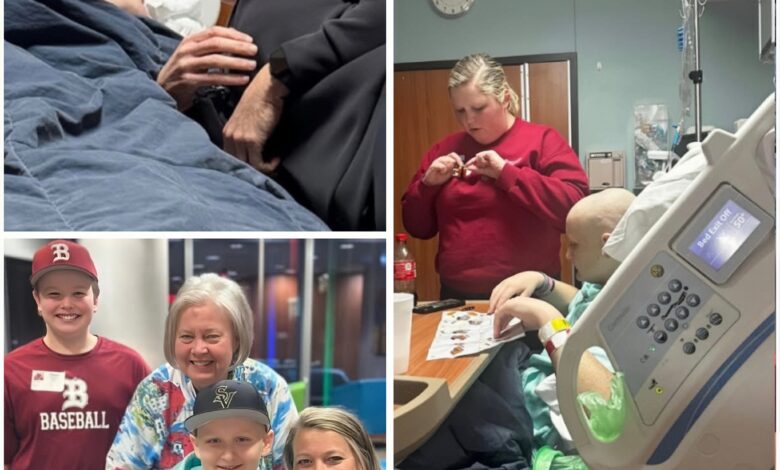
In the sterile, white-walled corridors of oncology wards, words usually have fixed meanings. “Growth” is the enemy. “Shrinkage” is the victory. But for Will Roberts and his family, the latest medical report has flipped the script of modern medicine on its head, presenting a paradox that is as confusing as it is hopeful.
How can a tumor get bigger while it is dying? Can a “worse” scan actually be the miracle everyone has been praying for?
A Victory in the Bone
The update began with a breath of collective relief. For months, the primary site of the cancer in Will’s leg has been the focal point of intense radiation and chemical warfare. The fear with bone-related cancers often lies in “skip lesions”—tiny, aggressive satellites of disease that jump away from the main tumor, making surgical removal nearly impossible without total amputation.
The latest confirmation from Will’s surgical team was nothing short of a breakthrough: The cancer in his leg is no longer active. The skip lesions, once the greatest threat to his mobility, are dead. This news has fundamentally shifted the surgical conversation. What was once a high-risk gamble to save the limb has become a calculated plan for recovery. The “inactive” status means the primary fortress of the disease has been breached and neutralized.
But as any family walking the path of Stage IV cancer knows, the body is a vast battlefield, and victory in one province does not mean the war is over.
The Lung Paradox: When “Larger” Doesn’t Mean “Stronger”
The heart of the latest report contains a sentence that stopped the Roberts family in their tracks: Two cancerous nodules in the lungs are larger.
In the binary world of “good news” and “bad news,” growth is almost always the latter. It usually signals a failure of the current treatment protocol or a mutation of the cells to bypass chemotherapy. However, the oncologists quickly pointed to a second, more vital descriptor: Necrotic.
To the layperson, “necrotic” sounds grim—it stems from the Greek word nekros, meaning dead. But in oncology, necrosis within a tumor is a “Holy Grail” of treatment response.
The Science of the “Dead Balloon” Medical experts explain this phenomenon using the analogy of a balloon or an inflammatory response. When aggressive chemotherapy or immunotherapy successfully attacks a tumor, the internal cells die off. This “cell death” (necrosis) often triggers an inflammatory response. The body sends fluids and immune cells to the site to clean up the debris, causing the mass to swell or appear larger on a CT scan.
Furthermore, a necrotic tumor is essentially a hollowed-out shell. It has lost its blood supply; it has lost its ability to divide; it has lost its “life.” It is a graveyard of cancer cells. While the physical footprint of the nodule has expanded, its biological power has been extinguished.
For Will, this means his lungs are currently carrying the “corpses” of his tumors. The challenge now is determining if that necrosis is total or if a living core remains.
The Emotional Rollercoaster: Holding Hope Carefully
For the followers of Will’s journey, this update is “hope—carefully held.” The psychological toll of interpreting these reports cannot be overstated. When you are fighting for your life, you become a student of Latin roots and radiological margins, searching for a sliver of light in a forest of clinical jargon.
“It’s like being told you won the lottery, but you have to walk through fire to cash the ticket,” says one close supporter. “The leg is a win. The lungs are a ‘maybe.’ We are living in the space between those two realities.”
The transition from active cancer to necrotic tissue is a delicate phase. It requires the doctors to pivot from “killing the disease” to “managing the aftermath.” The next steps for Will involve rigorous monitoring to ensure the body can safely process the dead tissue and to confirm that no new, active “seeds” are being planted elsewhere.
Why This Story Matters
Will Roberts’ case is becoming a beacon for others navigating the complexities of advanced treatment. It highlights a crucial lesson in modern medicine: The report is not always the reality.
In an era of rapid medical advancement, we are seeing more cases where traditional markers of “progression” are actually markers of “pseudo-progression”—a temporary swelling that precedes a total collapse of the disease. Will is currently the living embodiment of this medical frontier.
His resilience has turned a personal tragedy into a community-wide vigil. Every “like,” every “share,” and every comment on his updates provides a layer of digital armor for a young man undergoing a physical transformation that most cannot imagine.
The Road Ahead
What comes next for Will?
- Surgical Planning: With the leg lesions inactive, surgeons can now move forward with a more definitive plan to stabilize the bone and restore function.
- Lung Monitoring: A follow-up PET scan or biopsy may be required to confirm that the “growth” in the lung nodules is indeed 100% necrotic tissue.
- Continued Systemic Therapy: To ensure the “war in the lungs” stays won, the medical team will likely continue a maintenance or aggressive cleanup phase of treatment.
How You Can Help
The Roberts family continues to face astronomical medical costs and the daily grind of long-term hospitalization. But beyond the financial, they are asking for the strength of the community.
“Follow for updates” isn’t just a social media call to action; it’s an invitation to stand in the gap for a family that is currently staring down a paradox. We are waiting for the day when “necrotic” turns into “gone,” and when “inactive” turns into “cured.”
Until then, we hold our breath. We analyze the scans. We celebrate the dead cells in the leg. And we pray that the “dying” growth in the lungs is the final gasp of a defeated enemy.