SSK “If AI and robotics can create a world of abundance, poverty might no longer be a necessity—but the real challenge will be redefining purpose, work, and human meaning in a life where survival is no longer tied to labor.”

AI, Abundance, and the Future of Human Purpose: Could Technology Finally End Poverty?
In recent years, artificial intelligence (AI) and robotics have moved from the realm of science fiction to the forefront of societal transformation. Industry leaders, technologists, and policymakers alike are grappling with questions that once seemed purely theoretical: What will the future of work look like? Will humans still need to labor to survive? Could technological advancement make poverty a relic of the past? Elon Musk, the CEO of Tesla and SpaceX, recently offered a bold vision in response to these questions, suggesting that AI-driven abundance could eventually eliminate poverty and make personal saving largely optional.
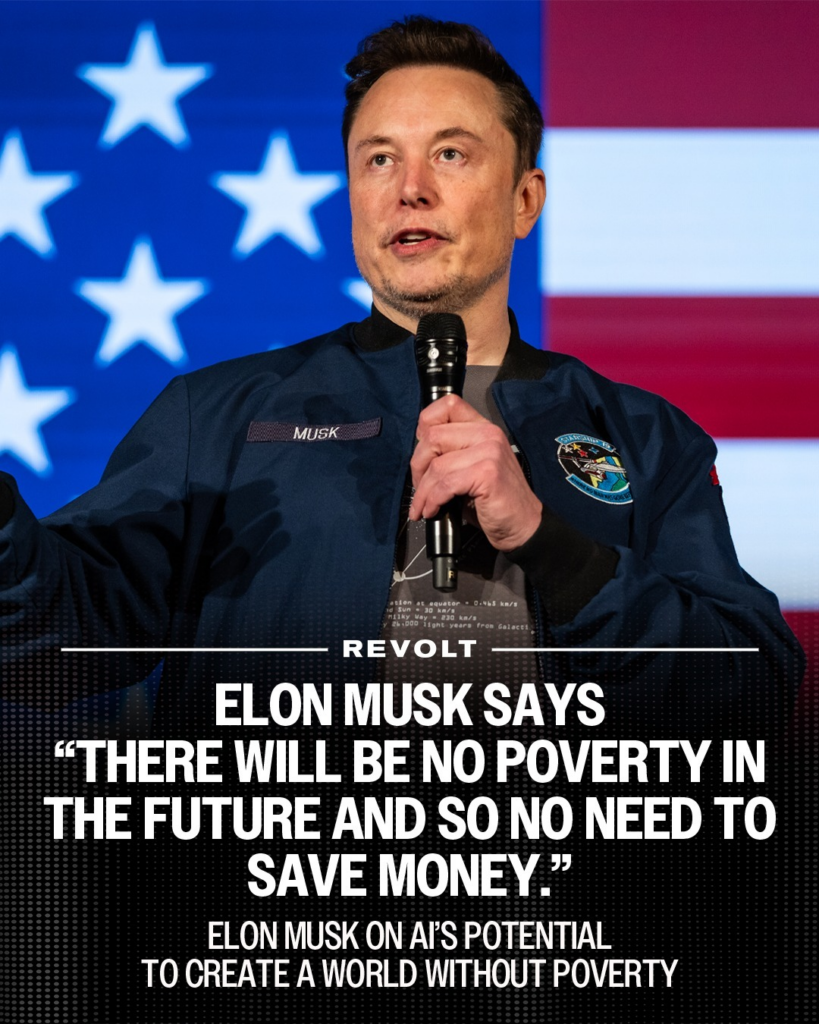
Musk’s comments, shared in a post on X while responding to investor Ray Dalio, framed a provocative idea: the emergence of what he calls a “universal high income.” In his view, advances in AI and automation could produce an economy so efficient and productive that traditional work becomes optional. Rather than requiring humans to earn money to survive, a system powered by intelligent machines could provide the essentials of life and more, creating unprecedented abundance. Musk emphasizes that this is not merely a utopian fantasy; he believes it is a realistic projection based on the pace of technological progress.
The implications of such a scenario are profound. For centuries, economic systems have been built around scarcity. Wages, employment, and personal savings exist because resources are limited, and humans must compete or cooperate to secure what they need. In a world where AI and robotics can produce goods and services efficiently, cheaply, and at scale, scarcity could be dramatically reduced. Food, housing, healthcare, education, and energy might be provided automatically or at minimal cost, effectively removing poverty as a structural condition of society.
However, Musk’s vision is not just about financial abundance. He also raises critical questions about meaning and purpose. Work has historically been more than a way to survive—it has given structure to daily life, a sense of identity, and social engagement. If machines take over most jobs, humans may find themselves free from financial necessity but confronted with a void of purpose. How would society ensure that individuals feel fulfilled, connected, and motivated in a world where their labor is no longer required? Musk suggests that this is a challenge that must be addressed in tandem with economic transformation.
The concept of a “universal high income” is distinct from traditional universal basic income (UBI) proposals. While UBI often envisions modest payments sufficient to cover essentials, Musk’s idea implies that AI-driven productivity could support a standard of living far beyond mere survival. In this scenario, citizens could have access to high-quality healthcare, housing, education, and leisure without engaging in traditional work, creating a radical redefinition of wealth and opportunity.
Skeptics, of course, question the feasibility of Musk’s vision. Economic systems are complex, and wealth is rarely distributed evenly. Even if AI can generate unprecedented productivity, political, social, and ethical barriers could prevent the benefits from reaching everyone. The transition itself may be fraught with tension, as jobs are displaced faster than societies can adapt. Moreover, reliance on AI and automation introduces new vulnerabilities: dependence on technology, potential bias in algorithmic decision-making, and the risk of concentrating control of resources in the hands of a few corporations or governments.
Yet the potential upside is too significant to ignore. Imagine a world where poverty no longer defines childhood, limits education, or forces people into grueling labor simply to survive. Imagine communities where innovation, creativity, and leisure are the default, rather than the exception reserved for the affluent. In such a society, humans could pursue endeavors motivated by curiosity, passion, and altruism rather than necessity. The elimination of poverty would not just be an economic victory; it could fundamentally transform culture, health, and social cohesion.
History provides some context for these transformations. Past technological revolutions—mechanization, electricity, the internet—disrupted labor markets, yet they eventually created new forms of work and prosperity. The AI era, however, may be different in scale and scope. Machines are not only taking over repetitive or manual tasks; they are increasingly capable of cognitive and creative work. If Musk’s predictions hold true, the abundance generated could dwarf anything humanity has seen before, offering a glimpse of a post-scarcity world.
The philosophical questions raised by this potential future are as important as the economic ones. If humans no longer need to work to survive, how do we define value, achievement, and identity? How do we cultivate motivation, ambition, and community engagement when basic survival is guaranteed? Educators, policymakers, and cultural leaders may need to rethink how society structures purpose, education, and personal development. Leisure, exploration, and creativity may become the primary currencies of meaning in a post-work society.

Moreover, the environmental implications are intertwined with this vision. If AI and robotics can produce abundance efficiently, humanity might reduce waste, optimize resource use, and shift toward sustainable practices. The combination of intelligent automation and renewable energy could create a world where prosperity and ecological responsibility coexist—a goal long pursued but rarely achieved at scale.
Musk’s vision is audacious, but it is also a reminder of the unprecedented power of technology to reshape the human experience. Abundance is possible, but it will require careful planning, ethical stewardship, and a societal willingness to rethink longstanding assumptions about work, wealth, and purpose. In a world of AI-driven abundance, the challenge will not be survival—it will be meaning.
Ultimately, Musk’s message is both hopeful and cautionary. AI and robotics could make poverty obsolete, providing humans with the security and freedom that previous generations could only dream of. Yet freedom without purpose risks leaving humanity adrift. The future Musk envisions is not simply a post-scarcity utopia; it is an opportunity to redefine what it means to live a meaningful life in a world where
survival is no longer the primary concern.
As Musk suggests, “If AI and robotics can create a world of abundance, poverty might no longer be a necessity—but the real challenge will be redefining purpose, work, and human meaning in a life where survival is no longer tied to labor.” The coming decades may determine whether this vision becomes a reality—and whether humanity can rise to meet the profound questions it poses.