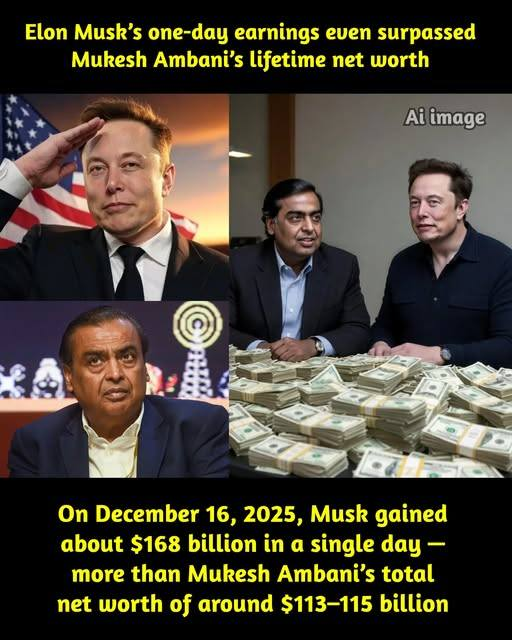
SSK “In today’s tech-driven world, fortunes are no longer built over lifetimes — they are made, shattered, and rewritten overnight.”

“In today’s tech-driven world, fortunes are no longer built over lifetimes — they are made, shattered, and rewritten overnight.”
For most of modern history, wealth followed a familiar rhythm. Fortunes were built slowly — brick by brick, generation by generation. Industrial tycoons spent decades expanding railroads, oil fields, and factories. Banking dynasties grew their power across centuries. Even in the early days of capitalism, time was the great equalizer: patience, endurance, and longevity defined success.

That world no longer exists.
Today, in an era ruled by algorithms, artificial intelligence, and hyper-connected markets, wealth has become volatile, compressed, and shockingly fast-moving. A single announcement, a sudden breakthrough, or a surge in investor sentiment can create billions overnight — or erase them just as quickly. The modern economy doesn’t reward waiting. It rewards speed.
And nowhere is this shift more visible than in the technology sector.
In the past decade alone, we have witnessed individuals leap from relative obscurity to global financial dominance in a matter of months. Startup founders become billionaires before their 30th birthdays. Tech CEOs see their net worth rise or fall by tens of billions in a single trading session. Entire industries are disrupted not gradually, but suddenly — often without warning.

The stock market, once a reflection of long-term industrial value, has transformed into a real-time referendum on belief, expectation, and narrative. Prices no longer move solely on earnings or assets. They move on vision. On future promises. On the perception of innovation.
This is why fortunes today are no longer “built.”
They are triggered.
A new AI model.
A successful rocket launch.
A regulatory approval.
A viral product announcement.

Each of these moments can act as a financial detonator, instantly reshaping the balance of global wealth. What once took a lifetime to accumulate can now be created in a single night — while markets sleep and algorithms trade.
But the same forces that create wealth at lightning speed also make it dangerously fragile.
The modern tech-driven economy is unforgiving. A data breach, a missed earnings report, a shift in regulation, or a sudden loss of public trust can wipe out years of gains in hours. We have seen companies valued in the hundreds of billions collapse almost overnight. We have seen founders celebrated as visionaries one day, and questioned or sidelined the next.
In this environment, wealth is no longer a destination — it is a condition, constantly changing, constantly under threat.

This volatility has profound consequences, not just for billionaires, but for society as a whole. When fortunes are created at extreme speed, inequality widens faster than institutions can respond. Traditional systems — taxation, regulation, labor protections — were designed for a slower economy. They struggle to keep pace with wealth that materializes digitally, moves globally, and shifts by the minute.
At the same time, the myth of permanence has collapsed.
For generations, extreme wealth implied stability and legacy. Today, even the richest individuals understand that their position is temporary. Rankings change weekly. Net worths fluctuate daily. The title of “world’s richest person” has become less of a crown and more of a snapshot.
This has altered how power itself operates.
In the past, wealth conferred long-term influence. Today, influence must be constantly defended. Tech leaders are expected to innovate relentlessly, communicate continuously, and adapt instantly. Standing still is no longer neutral — it is fatal. In a market driven by expectation, failure to move forward is interpreted as falling behind.
This relentless pressure explains why modern tech empires feel perpetually unfinished. There is no final version. No end state. Every success simply raises the stakes for the next moment.
Yet despite its instability, the tech-driven wealth system continues to attract global capital at unprecedented levels. Why? Because the upside is irresistible. The possibility that a single idea, a single platform, or a single breakthrough could reshape the world — and generate unimaginable value — remains the most powerful economic narrative of our time.
Investors chase speed because speed is where outsized returns live.
But for every overnight success story, there are countless unseen collapses. For every fortune rewritten upward, another is erased quietly, without headlines. This asymmetry creates a culture obsessed with winners while ignoring the structural risks underneath.
The truth is uncomfortable: modern wealth is not just faster — it is more unstable than ever before.
And yet, this instability may be the defining feature of the future economy.
As artificial intelligence accelerates decision-making, as markets become more automated, and as information spreads instantly across the globe, the compression of time will only intensify. The gap between creation and destruction will shrink further. What feels extreme today may soon feel normal.
In this world, adaptability replaces patience. Awareness replaces legacy. And resilience replaces permanence.
Fortunes will continue to rise overnight.
They will continue to fall just as fast.
And history will continue to be rewritten — not over generations, but over news cycles.
Because in today’s tech-driven world, wealth no longer waits for time to pass.
It moves at the speed of code.