The summer of 2009 would be remembered forever in Australia.
It was a season of searing heat, relentless winds, and fire—the kind of fire that devoured everything in its path. The eucalyptus forests of Victoria burned like dry paper. The sky turned orange and black, the sun disappeared behind a curtain of smoke, and the air was thick with ash.
In the midst of this chaos, Sam the koala was alone.
Her forest, once full of life and the rustle of leaves, had turned into a landscape of crackling flames. The trees she had climbed since birth were burning. The smell of eucalyptus that once meant safety now mixed with smoke and death. Her small body trembled as she tried to escape the inferno. Her fur was singed, and her paws, once soft and gray, were burned and raw from climbing the hot bark of blackened trees.
She didn’t understand what was happening. She only knew she had to keep moving—to survive.
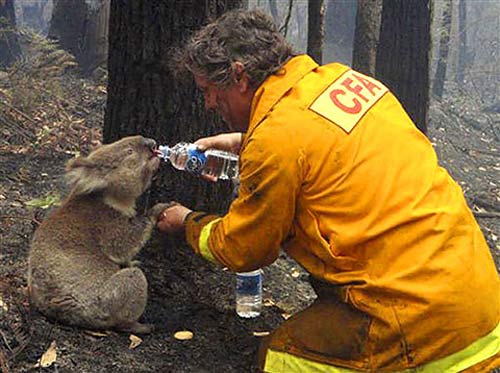
Miles away, David Tree, a volunteer firefighter, was standing near his truck, wiping the sweat and soot from his face. He had been fighting fires for two days without real rest. His uniform was black with ash, and his throat burned from smoke inhalation. The team had just finished containing a blaze near Mirboo North, one of countless fires raging across Victoria.
The world around them looked like the end of time—acres of charred earth, the twisted skeletons of trees, and the silence that follows destruction. Not even the birds were singing.
David and his crew were preparing to move on when he saw something in the distance. At first, he thought it was a child’s toy—a stuffed animal left behind in the rush to evacuate. But then it moved. Slowly. Painfully.
A koala was walking across the blackened ground, its fur scorched, its ears drooping. It was limping, and each step seemed to cause it agony.
David froze. “Oh, you poor thing,” he murmured, walking toward it carefully. He could see the animal’s eyes—wide, glazed, and full of confusion. The fire had stripped away everything familiar to it.
The koala stopped, watching him approach. She didn’t run. She couldn’t.
David crouched down and removed the cap from his water bottle. “Hey, little one,” he whispered. “It’s okay. I won’t hurt you.”
The koala tilted her head slightly, as if trying to decide whether to trust him. Then, in one heartbreaking moment, she reached out—her burned paw trembling—and placed it on his arm.
The touch was soft, almost human.
David felt his throat tighten. Gently, he held the bottle to the koala’s mouth. She began to drink, desperately, the water dripping down her chin and onto his soot-covered hand. She kept drinking, as if it was the first water she’d had in days. David smiled despite the smoke stinging his eyes. “That’s it, sweetheart,” he whispered. “Drink up.”
Someone from his crew called out, “Hey, Dave! You okay?”
He didn’t look up. “Yeah,” he said softly. “Just… helping someone.”
Another firefighter came over and took a photo. In the frame, the world was still burning, but in the center, a man knelt in the ashes, offering water to a helpless creature. It was a moment of grace amid destruction—a reminder that even in the darkest times, compassion survives.
When the koala finished drinking, David gently lifted her into a blanket. She didn’t resist. He could feel her small heartbeat against his chest. “We’ll get you some help, love,” he promised.
They drove her to a wildlife rescue center nearby. The staff took her in immediately, treating her burns and cleaning her wounds. They named her Sam.
David visited her a few days later. She was wrapped in soft bandages, her paws covered, her fur slowly growing back. When she saw him, she blinked and lifted her paw again, as if to say hello. David laughed quietly. “You remember me, huh?”
The rescuers told him that Sam was healing well. They expected her to make a full recovery. The news gave David hope—something rare during those days.

Meanwhile, the photograph of that moment—the firefighter giving water to a koala—spread around the world. Newspapers printed it on their front pages. People from every continent saw it and felt something stir inside them.
It became a symbol of humanity’s connection with nature—a reminder that kindness could exist even in the middle of destruction. Donations flooded into Australian wildlife rescue organizations. Children sent letters and drawings to “the brave firefighter who saved the koala.”
David was overwhelmed by the attention. He hadn’t done it for recognition. He had done it because, in that moment, it was the only thing that felt right. “It wasn’t heroism,” he told a reporter later. “It was just decency. She needed help. That’s all.”
Weeks passed, and the fires finally began to fade. Rain fell again, washing the ashes from the leaves, and tiny green shoots appeared in the soil. Life, as it always does, began to return.
David went back to visit Sam one last time. She was stronger now, her burns nearly healed. She climbed carefully around her enclosure, a little slower than before but determined.
When David entered, she turned toward him, blinking her dark eyes. He knelt and extended his hand, and once again, she placed her paw on his arm. It was the same gentle touch as before—the touch of trust.
The caretakers decided that when Sam was ready, they would release her back into the wild. “She belongs to the forest,” David said, smiling. “She deserves to go home.”
And when that day came, the sky was blue again. The trees still bore the scars of the fire, but new leaves were growing. Sam climbed onto a branch and paused for a moment, looking down at the people who had saved her. Then she turned and disappeared into the forest.
David stood there for a long time, staring at the spot where she vanished. He thought of all the creatures that hadn’t made it, of the families who had lost homes, of the lives changed forever by the fire. But he also thought of Sam—the small, burned koala who had survived because of a single act of kindness.
In a world so often divided by chaos and fear, that one image—a firefighter sharing water with a wounded animal—became something larger than either of them. It became a promise: that even when the world burns, compassion will always find a way to survive.
Months later, when David returned to duty in another region, someone showed him a calendar featuring the photograph. Beneath it were the words:
“Hope can be found even in the ashes.”
He smiled quietly and tucked it into his bag. To him, it wasn’t just a slogan. It was the truth. Because he had seen hope—with fur, burned paws, and dark trusting eyes—on a day when the world was on fire.