TN. “Elon Musk Says Robots Will Soon Walk Your Dog and Babysit Your Kids — Are We Ready for This Future?”

A Future That Once Felt Distant Now Knocks at the Front Door
For decades, visions of household robots belonged to science fiction — films, comic books, and futurist predictions that always seemed just out of reach. But according to Elon Musk, that future isn’t arriving “someday.” It’s arriving now.
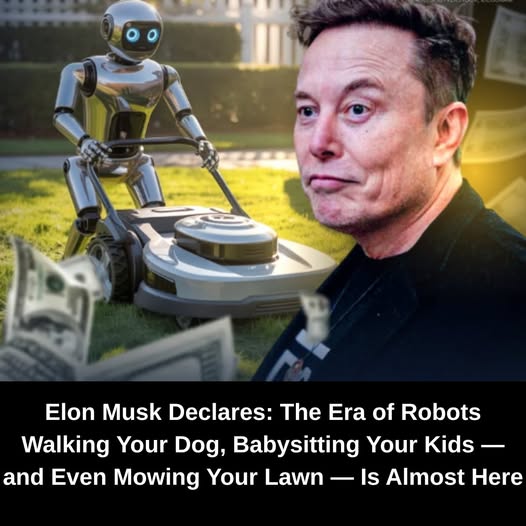
During a recent investor discussion in Riyadh, Musk outlined a bold and startling timeline: robots capable of walking your dog, mowing your lawn, assisting with childcare, and performing everyday tasks may soon become an ordinary part of life. The announcement sent a ripple across global tech circles and raised an essential question for Western audiences: Are we truly prepared for robots in our homes?
From Factory Floors to Neighborhood Streets
Robots have long been used in industrial settings, but integrating them into daily domestic life is an entirely different frontier. Musk’s vision centers on humanoid robots — machines designed not just to move like humans, but to adapt to the unpredictable rhythm of family life.
According to Musk, these robots will be capable of:
- Walking household pets
- Basic childcare assistance
- Outdoor maintenance, including lawn care
- Interactive communication and task planning
If realized, the implications extend far beyond convenience. These machines could redefine work, parenting, time management, and even social norms.
Optimus: The Robot at the Center of the Conversation
Much of the excitement — and anxiety — stems from Tesla’s ongoing development of Optimus, its humanoid robot. Early demonstrations showed a machine capable of dancing, sorting objects, and performing basic motor tasks. But Musk suggests that the public demonstrations are only a glimpse of what’s coming.
While speaking to investors, he described a near-term world where Optimus units perform household duties autonomously. Not pre-programmed routines, but adaptive behavior driven by AI.
This marks a major shift: robots are moving from tools to teammates.
Excitement Meets Unease
Musk’s announcement has generated two powerful — and opposing — reactions among American and European audiences.
The excitement:
- Convenience at a new scale
No more searching for babysitters at the last minute. No more pushing a lawn mower on hot weekends. No more stressing about dog walks after long workdays. - Efficiency and productivity
With routine tasks automated, individuals could reclaim hours each week. - New economic opportunities
Robotics may spark new industries, job categories, and educational pathways.
The unease:
- Safety and ethical concerns
How much autonomy should a household robot have? What safeguards must exist when a robot interacts with children? - The “Terminator scenario” Musk himself referenced
His own comments about the potential dangers of AI loom large in public imagination. - Privacy implications
A robot capable of navigating your home will, inevitably, have access to personal spaces and routines.
The debate is no longer hypothetical. It is immediate and urgent.
A Future That Sparks Both Hope and Warning
Elon Musk’s remarks included an acknowledgement of the dual-path nature of AI advancement. Yes, these robots can transform everyday life. But they also must be handled responsibly.
Musk has, for years, spoken about AI risk — sometimes dramatically. His reference in Riyadh to a potential “Terminator-like outcome” wasn’t meant to fuel panic, but to underscore the necessity of guardrails.
His overarching message: rapid progress requires rapid responsibility.
Why This Announcement Matters Globally
The idea of household robots will resonate differently across cultures. In North America, the concept appeals to households overwhelmed by work-life imbalance. In Europe, where regulations on AI and robotics tend to be more conservative, questions of safety, rights, and oversight immediately emerge.
But globally, the pattern is clear:
Artificial intelligence is transitioning from abstract technology to domestic reality.
This shift reshapes conversations around:
- Employment
- Family dynamics
- Legal responsibility
- Ethics
- Human–machine interaction
The introduction of robots into daily life could become the most significant transformation of the 21st century.
How Close Are We Really?
This is the question technologists, regulators, and everyday consumers are asking. Musk insists the timeline is short — perhaps a few years.
Skeptics point out that Tesla’s robotics demonstrations remain impressive but limited. Many engineers believe we are still several breakthroughs away from reliable home-assistant robots.
Yet even critics acknowledge:
The momentum is real.
Advances in machine learning, computer vision, and battery efficiency mean that robots capable of functional household roles are no longer fantasy. They are prototypes.
And prototypes, historically, become products faster than anyone expects.
The World Is Preparing — With Caution
Governments across Europe have begun accelerating AI regulatory frameworks. U.S. policymakers are conducting hearings on AI responsibility. Tech companies are assembling internal ethics teams.
But perhaps the more important question is philosophical:
How do humans adapt when robots become part of the family environment?
We adapted to smartphones.
We adapted to smart speakers.
Will humanoid robots be next?
A New Era Begins
Whether Musk proves accurate on timing is almost irrelevant. What matters is that a cultural shift has begun. Conversations once reserved for science-fiction fans are now happening in boardrooms, living rooms, and government halls.
If robots are about to walk our dogs, babysit our kids, and care for our homes…
then the future is no longer something we are waiting for. It is something we are stepping into — cautiously, curiously, and together.