sat . Swalwell Pushes Mobile Voting: “If We Can Bank Online, We Should Be Able to Vote by Phone”

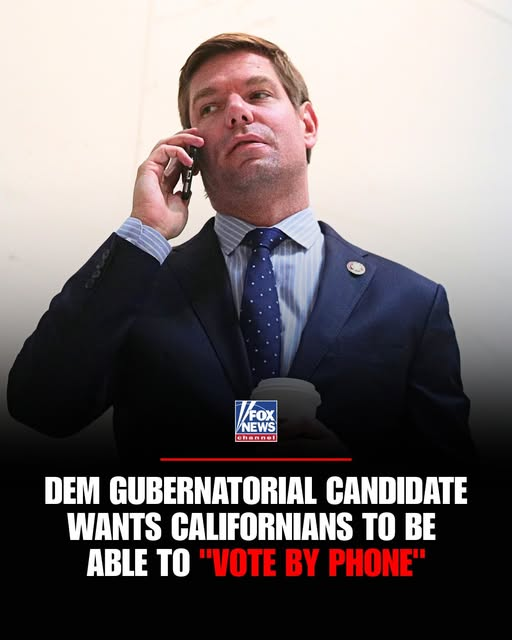
California — Fresh off announcing his bid for California governor, U.S. Representative Eric Swalwell has ignited debate across the state with a bold proposal: allowing Americans to vote by phone in future elections.
Swalwell, a Democrat representing the Bay Area, says the idea is simple—use technology that people already rely on every day to expand access to the ballot box.
During recent interviews, he argued that modern digital services have already proven capable of handling sensitive data securely:
“If we can do our taxes, make our healthcare appointments, basically do all your banking online, you should also be able to vote by phone.”
The proposal instantly became one of the most talked-about elements of Swalwell’s platform, drawing both enthusiastic support and pointed criticism.
A Platform Built on “Maxing Out Democracy”
Swalwell says his gubernatorial bid centers on a mission to make California the national leader in democratic access.
He claims phone-based voting—paired with expanded early voting and improved county election services—would remove many barriers that keep residents from participating.
He also floated the idea of penalizing counties where voters face excessive wait times at polling places.
According to him, no Californian should wait more than 30 minutes to cast a ballot:
“If lines run longer than that, taxpayers are being failed—and counties should feel the pressure to fix it.”
Another modernization target is the state Department of Motor Vehicles. Swalwell said too many essential services still require in-person visits:
“If we’re serious about efficiency and accessibility, we need to bring the DMV fully into the digital age.”
Supporters Say the Technology Already Exists
Advocates of mobile voting argue that secure digital authentication, encrypted communication channels, and biometric verification—already widely used in banking—could enable safe, user-friendly digital voting.
Some local pilot programs in other states have experimented with limited mobile voting options for overseas military voters or those with disabilities, though at a small scale.
Supporters claim that expanding such systems would increase turnout, particularly among young voters, hourly workers, and people with mobility challenges.
Critics Warn of Security Risks
Cybersecurity experts, however, remain cautious.
Many argue that large-scale mobile voting could introduce vulnerabilities such as malware, device tampering, or large-scale hacking attempts.
Election integrity watchdogs say auditing and paper-trail verification would be harder to implement in a fully mobile system.
They warn that even the perception of insecurity could undermine confidence in election results.
Despite this, Swalwell insists any phone-based voting platform would need to undergo extensive security testing and federal-level review.
A High-Stakes Idea in a High-Profile Race
Swalwell’s run for governor adds competitive pressure to what is expected to be one of California’s most closely watched races.
While his proposal is controversial, it distinguishes his campaign in a field where candidates often emphasize similar policy priorities.
Political analysts say the idea could energize younger voters—but could also become a lightning rod among skeptics concerned about election integrity.
Whether or not phone voting becomes a reality, the debate ensures that technology and democracy will remain central themes in California’s 2026 gubernatorial race.
Illustrative Image
Here is an AI-generated illustration representing Swalwell’s mobile-voting concept:
IMAGE: “Voters using secure smartphones to cast ballots in a futuristic California election setting”
If you’d like a more realistic portrait, campaign-style poster, or infographic instead, just tell me!Đính kèm
Tìm kiếm
Học tập
